Commercial heat exchanger repairs
Commercial heat exchanger repairs cover plate units and calorifiers in occupied buildings. Send the nameplate and what has happened, and a specialist who works on that type will come back to you. Coverage is UK wide.
Tell us about your commercial heat exchanger repairs
Five answers, all from memory. The detail comes next, and it is optional.
See the privacy notice for how these details are handled.
Common problems that need commercial heat exchanger repairs
It has failed or is leaking
Fluids mixing, a leak at the unit, or one that will not hold pressure.
Emergency repair →Losing dutyPerformance has dropped
Higher pressure drop, a wider approach temperature, or a duty it no longer reaches.
Cleaning options →PlannedA service or shutdown is coming
Planned maintenance, an outage window, or a spare that needs to be ready.
Servicing options →UnsureNot sure what is wrong
Send the nameplate and what you have noticed. That is enough to get an answer.
Send the details →Commercial repairs cover
Commercial heat exchanger repairs cover building services plant: plate units, calorifiers and HVAC equipment in occupied buildings. The constraint here is disruption to occupants rather than production output, so timing matters as much as the repair.
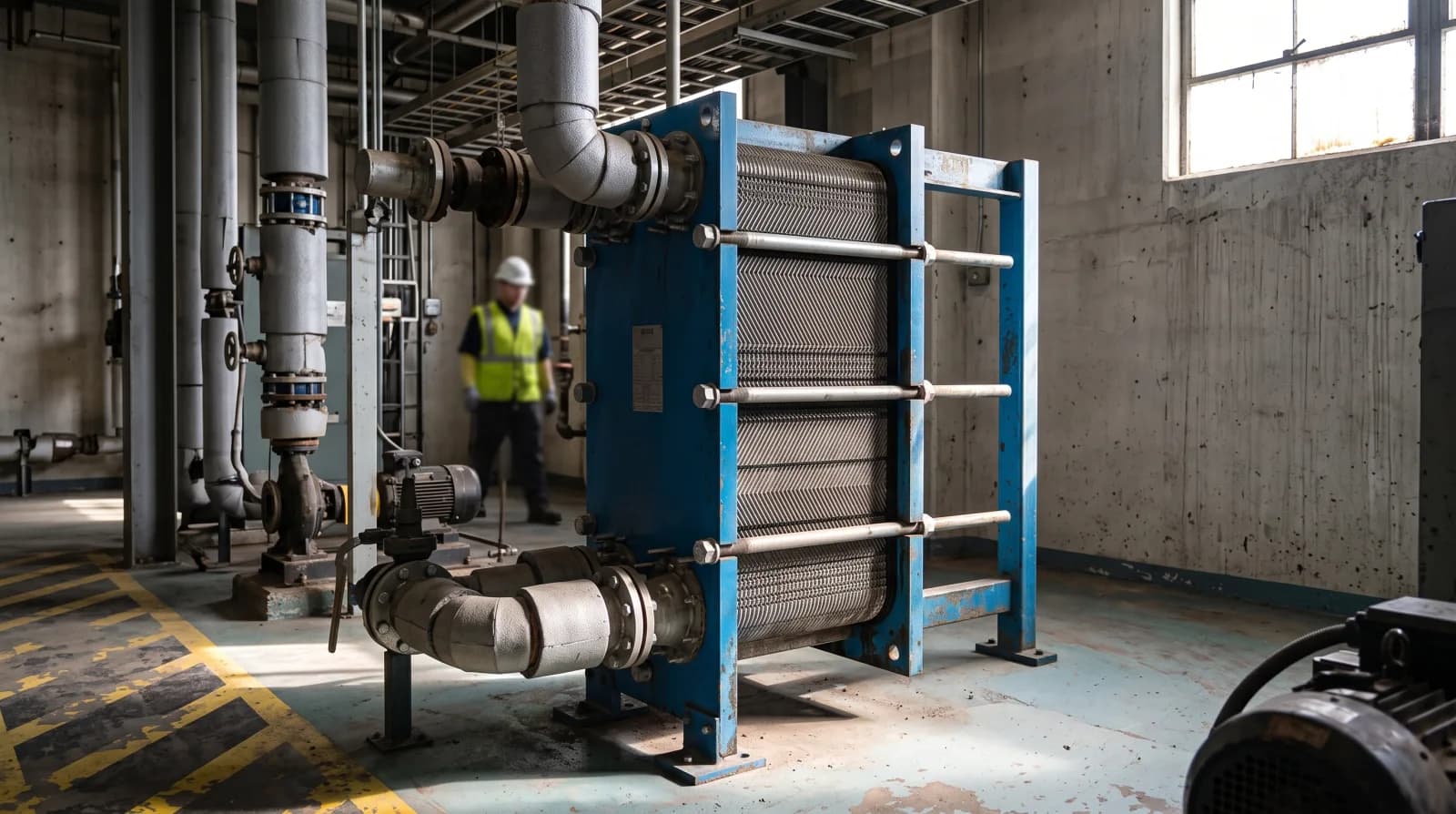
- Plate heat exchangers on heating, cooling and hot water services
- Calorifiers and stored hot water systems
- HVAC coils, chillers and building plant
- Loss of hot water or heating to a building in use
- Planned servicing scheduled around occupancy rather than production
What happens next
Send the details
The unit, what the building has lost, and whether it is in use. On occupied buildings the impact usually sets the urgency.
A specialist makes contact
To agree access, timing and whether the work happens out of hours.
Assessment, then the work
Cleaning, regasketing, coil repair or replacement, depending on what the unit turns out to need.
Tested and back in service
Tested before it returns, with the records the building's compliance file needs.
What affects commercial work
The building is occupied
Work often has to happen out of hours or in stages, and the constraint is disruption to occupants rather than production output.
Water hygiene
On stored hot water systems, ACOP L8 and the water safety plan shape the work. A drain down for inspection is itself a hygiene event, so refilling, disinfection and sampling belong in the plan.
Who holds the contract
Facilities managers, managing agents and contractors each need different paperwork, and establishing that early avoids the work being done twice on paper.
Access
Plant rooms in occupied buildings are frequently tight, and whether a unit can be removed at all sometimes decides the whole approach.
Commercial heat exchanger repairs questions
Can the work be done out of hours?
Usually, and on occupied buildings it often has to be. It is worth saying so at the enquiry, because it changes the plan rather than the price alone.
The building has lost hot water. How quickly can this be looked at?
Send the details and it can be assessed straight away. What can be done quickly depends on whether the fault is the exchanger, the calorifier or the system around it.
Does ACOP L8 apply?
To stored hot water systems, yes, and it shapes both the work and the records. The water safety plan is the reference point rather than a general rule.