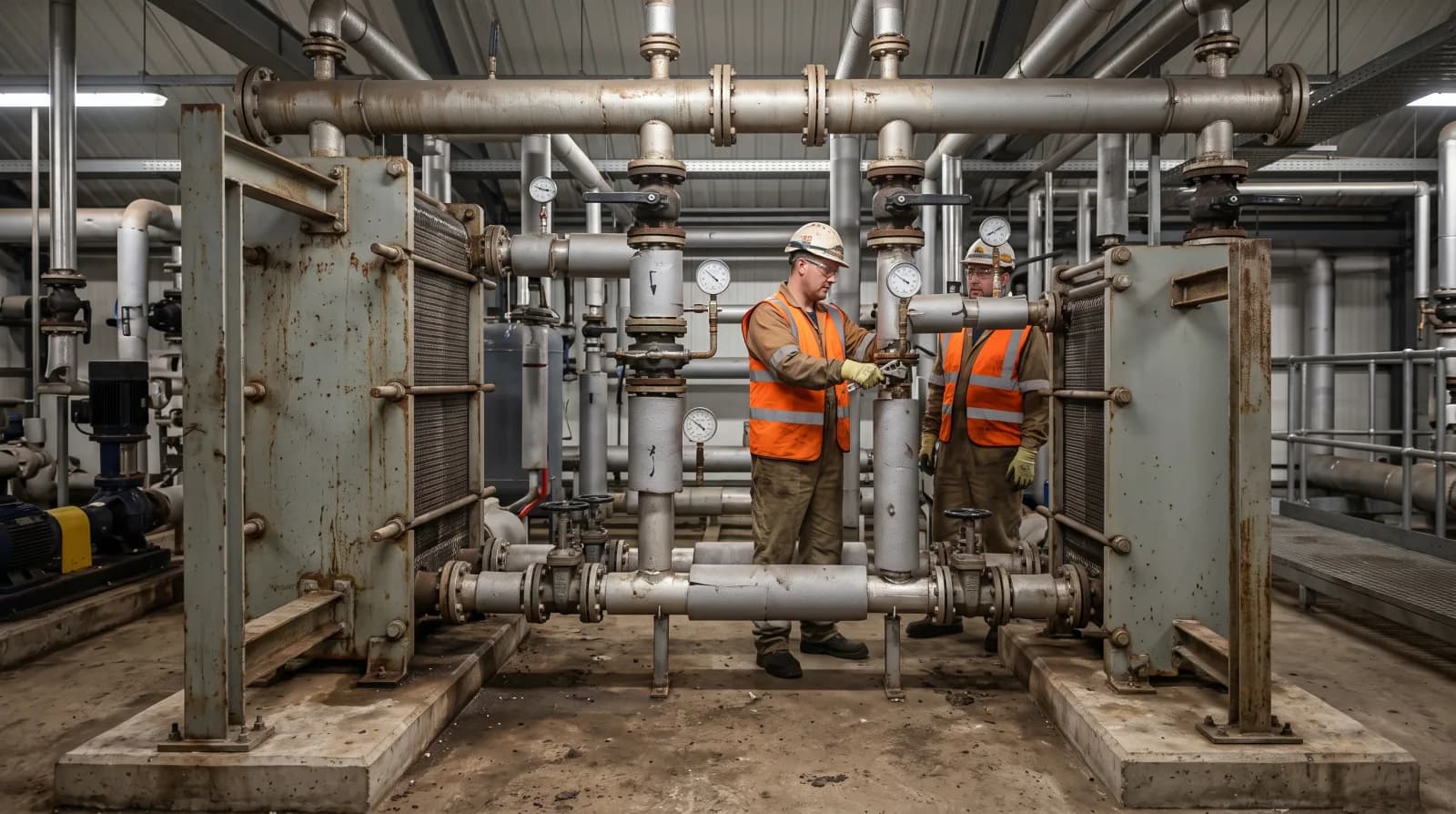
Heat exchanger servicing
Heat exchanger servicing catches wear and fouling before they stop the plant. Send the nameplate and what has happened, and a specialist who works on that type will come back to you. Coverage is UK wide.
Tell us about your heat exchanger servicing
Five answers, all from memory. The detail comes next, and it is optional.
See the privacy notice for how these details are handled.
Common problems that need heat exchanger servicing
It has failed or is leaking
Fluids mixing, a leak at the unit, or one that will not hold pressure.
Emergency repair →Losing dutyPerformance has dropped
Higher pressure drop, a wider approach temperature, or a duty it no longer reaches.
Cleaning options →UnsureNot sure what is wrong
Send the nameplate and what you have noticed. That is enough to get an answer.
Send the details →When to service a heat exchanger
Heat exchanger servicing is planned work on a unit that has not failed. Its purpose is knowing the condition of the unit while you still have a choice about when it comes off line. Servicing earns its place in these cases.
- The unit is on a critical duty with no standby to swap in
- Performance has drifted gradually rather than failed suddenly
- A planned shutdown is coming and the exchanger is the item nobody has opened
- The unit has no service history, or was inherited with the plant
- Cleaning intervals have been getting shorter
What heat exchanger servicing covers
Record the condition as found
Performance figures, the state of the unit and, on plate equipment, the plate order and pack dimension before anything is disturbed.
Strip and clean
Deposits come off so the surfaces underneath can actually be assessed. Nothing useful can be judged through fouling.
Inspect
Plates are checked for cracks and pinholes, tubes for wall loss. Inspection is the part that separates a service from a clean.
Replace what needs it
Gaskets as a set, plates or tubes that fail inspection, and any fasteners that are past use.
Rebuild and test
Rebuilt to the correct dimension, then pressure tested before it goes back into service.
Report
What was found, what was replaced, and what to watch. Set against the last service, that is what tells you whether the interval is right.
Setting a servicing interval
Condition, not the calendar
Approach temperature and pressure drop are the honest triggers. A fixed interval tends to be either too early or too late.
How hard the duty fouls
The same unit on clean water and on a heavy process duty needs completely different intervals, which is why a general figure is not much use.
Whether a spare exists
A spare unit or plate pack turns a service into a changeover, and that usually decides whether work happens on site or in a workshop.
The examination scheme
Where the unit forms part of a pressure system, the written scheme of examination under PSSR 2000 sets requirements that the servicing plan has to fit around.
Heat exchanger servicing questions
What is the difference between servicing and repair?
A repair fixes something that has failed. A service is done before it fails, and its main output is knowing the condition of the unit. The two overlap when a service finds a fault, which is common enough that it should not be a surprise.
How often should a heat exchanger be serviced?
On condition. Trending approach temperature and pressure drop gives a real trigger, and duties that foul hard need attention far more often than the same unit on clean water.
Can servicing be done without taking the plant down?
Where there is a spare or a bypass, yes. Without one, the duty is off line for as long as the work takes, which is usually what decides the approach.