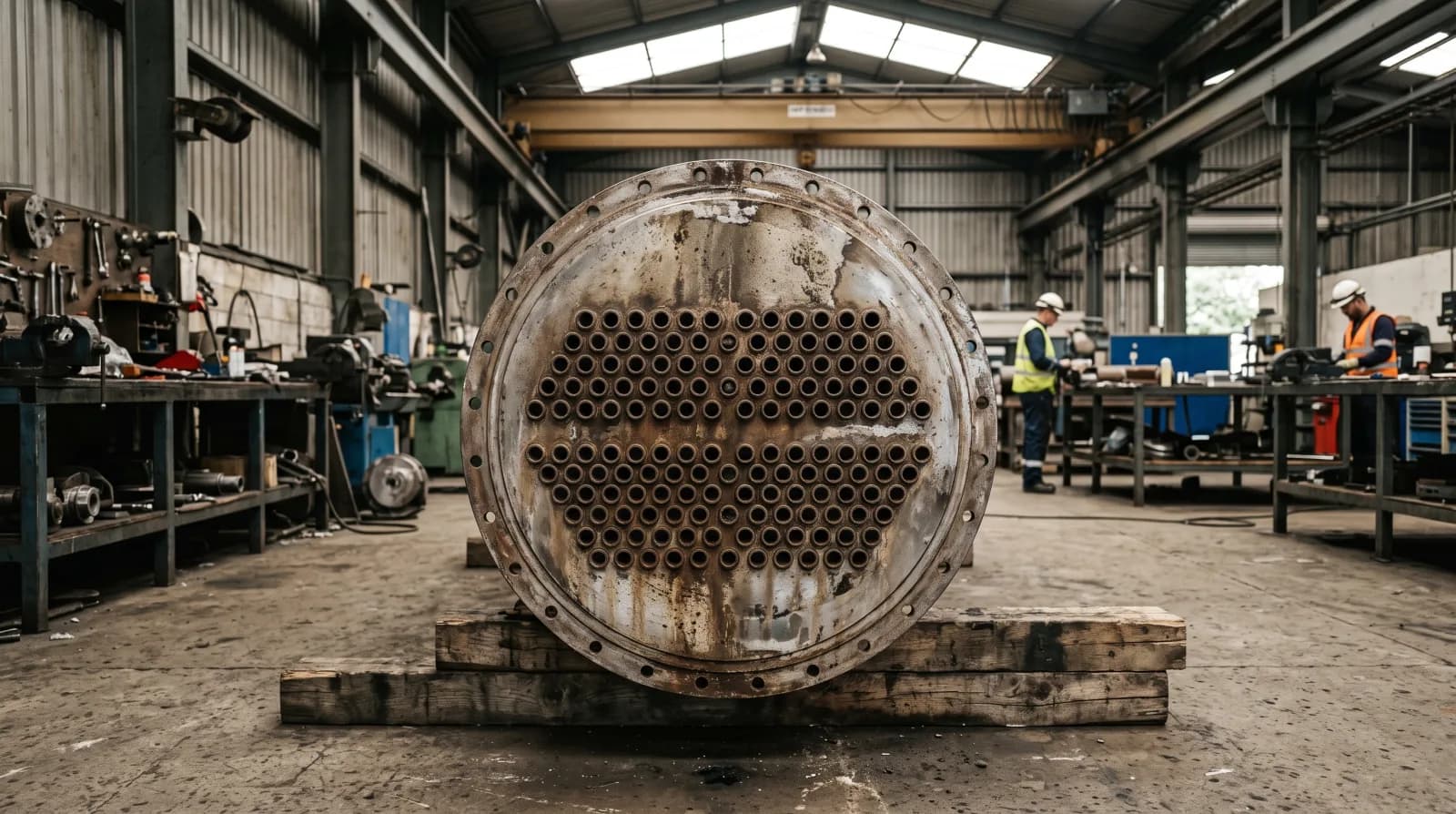
Heat exchanger corrosion
Heat exchanger corrosion thins the metal that separates the two fluids, so unlike fouling it does not just cost performance, it eventually causes a leak.
Tell us about your heat exchanger corrosion
Five answers, all from memory. The detail comes next, and it is optional.
See the privacy notice for how these details are handled.
Common corrosion mechanisms
Heat exchanger corrosion thins the metal separating the two fluids, so unlike fouling it does not simply cost performance, it eventually causes a leak. These are the mechanisms behind most corrosion.
- General corrosion
- Even loss across the surface, usually from water chemistry that does not suit the material. General corrosion shows up as gradual wall thinning across the bundle, not as one failure.
- Pitting
- Localised attack that penetrates quickly while most of the surface still looks sound. Chlorides in cooling water are a frequent cause on stainless.
- Erosion corrosion
- Metal loss where flow is fast or turbulent, classically at the inlet end of tubes. Erosion corrosion shows as failures grouped in one area, not spread across the bundle.
- Galvanic corrosion
- Two different metals in contact with an electrolyte between them. Galvanic risk is why plug and tube materials are matched, not chosen for convenience.
- Stress corrosion cracking
- Cracking under the combination of tensile stress and a specific environment. Stress corrosion cracking can leave a unit that looks sound and is not.
What can be established
- Whether the loss is general or localised, which points at different mechanisms and different remedies
- How much wall thickness is left, measured rather than estimated, on the tubes or plates that matter
- Whether the material suits the duty it is actually on, which may have changed since the unit was specified
- Whether the rate is stable or accelerating, which needs two sets of results rather than one
Heat exchanger corrosion questions
What are the four types of heat exchanger failure?
Fouling, corrosion, mechanical failure and gasket or seal failure covers most of what is found. Fouling costs performance, corrosion thins the metal separating the two fluids, mechanical failure covers vibration, thermal cycling and tube to tubesheet joints, and seal failure leaks without damaging the unit.
How does a heat exchanger get damaged?
Corrosion from water chemistry or process fluid, erosion where flow is fast, fouling that insulates and traps deposits against the surface, and mechanical damage from vibration, thermal cycling or over-tightening. Most failures are one of those four.
Can you run a unit with a cracked heat exchanger?
That is a decision for the plant rather than for a web page, and it turns on where the crack is and what the two fluids are. Where a crack lets fluids mix, running on means contaminating one circuit with the other.
Can a corroded heat exchanger be repaired?
It depends what has corroded. Tubes can be plugged or replaced and plates can be replaced. Corrosion of the shell or frame is a different matter, because that is the pressure envelope, and it needs assessment before the unit runs again.
How is corrosion found before it leaks?
By inspection. Wall thickness on tubes is measured by eddy current or ultrasonic methods depending on the material, and plates are checked for cracks and pinholes.
Should the material be changed?
If the original was wrong for the water chemistry or process fluid, a repair is the natural point to change it, and it is usually cheaper than doing the same job twice.