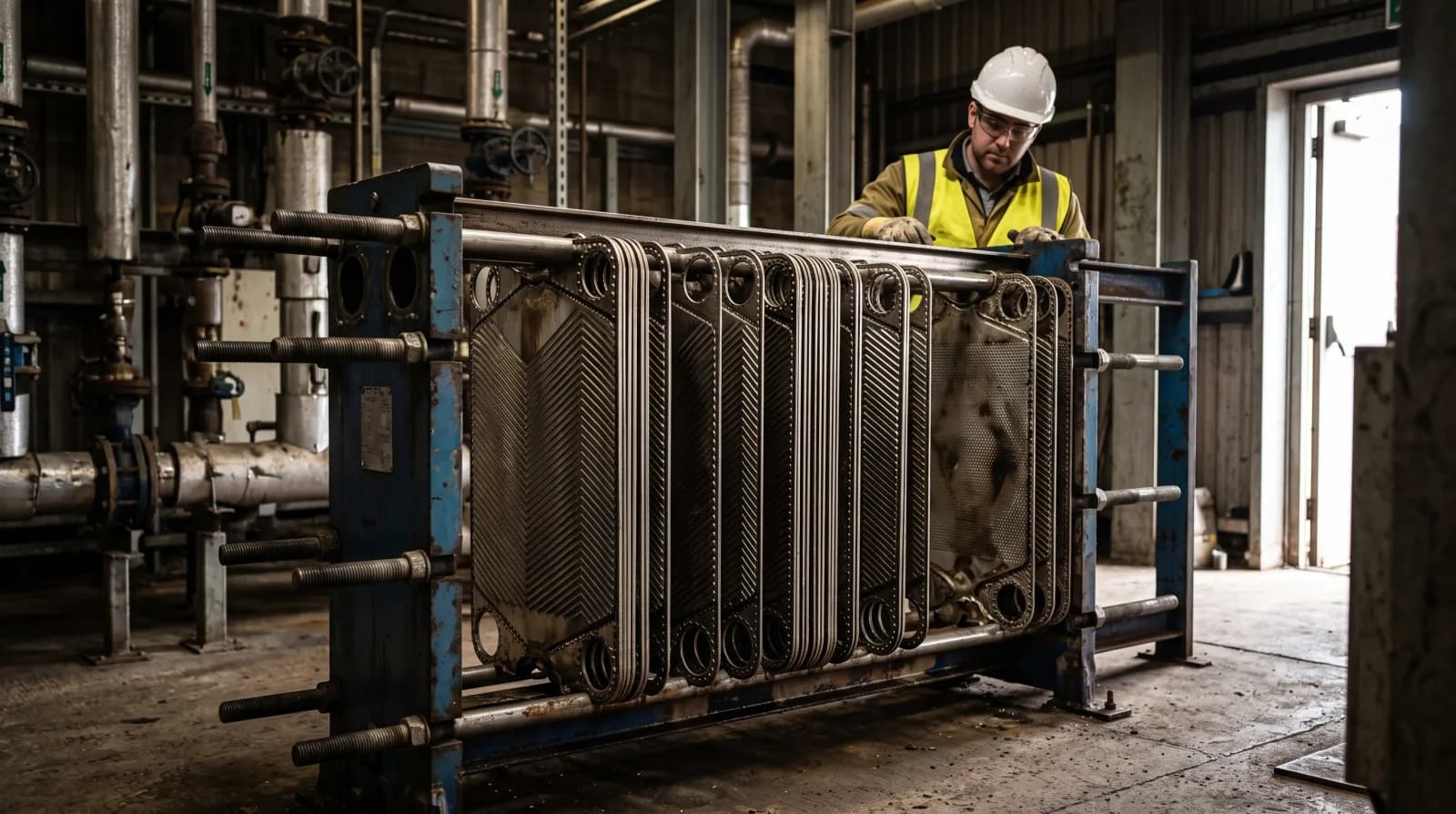
Emergency heat exchanger repair
Emergency heat exchanger repair restarts stopped production lines. Tell us what has stopped and whether the plant is down now. A specialist who works on that type of unit will come back to you.
Tell us about your emergency heat exchanger repair
Five answers, all from memory. The detail comes next, and it is optional.
See the privacy notice for how these details are handled.
Common problems that need emergency heat exchanger repair
Performance has dropped
Higher pressure drop, a wider approach temperature, or a duty it no longer reaches.
Cleaning options →PlannedA service or shutdown is coming
Planned maintenance, an outage window, or a spare that needs to be ready.
Servicing options →UnsureNot sure what is wrong
Send the nameplate and what you have noticed. That is enough to get an answer.
Send the details →Emergency heat exchanger repairs cover
Emergency heat exchanger repair is for a unit that has failed with production stopped or about to be. The work that gets a plant running again is not always the work that lasts longest, so the first decision is which of the two you need. These are the situations an emergency repair covers.
- Plant stopped by a failed heat exchanger
- Fluids mixing between circuits, contaminating product or the system
- A leak that cannot be isolated without shutting down
- A unit that has to keep running until a planned outage
- A spare that was supposed to be available and is not
What happens next
Send the details
Unit type, what has happened, and whether the plant is down. Two minutes, and it decides the approach before anyone travels.
A specialist makes contact
To confirm what has failed and agree whether the unit is repaired in place or moved.
Fast repair or full repair
Plugging tubes or replacing gaskets gets a unit back quickly. A strip and rebuild takes longer and lasts longer. How long the plant can be down decides which of the two is right.
Tested, then back in service
The unit is pressure tested before it returns, with the records the plant needs.
What affects how quickly a unit is back
What the failure turns out to be
Gaskets, a cracked plate, a leaking tube and a corroded shell are four different jobs and four different timescales.
Parts availability
Plates and gaskets are model specific. For older or discontinued units this is often the constraint rather than the labour.
Whether a spare exists
A spare unit or spare plate pack turns a breakdown into a changeover. Where there is none, the repair time is the downtime.
Access
What it takes to get the unit out, and whether it can be reached with the plant in its current state, changes the plan more often than the repair itself does.
Emergency heat exchanger repair questions
What information is needed to get moving quickly?
The nameplate, what has failed and how you know, and whether the plant is down now or still running. Those three answers are usually enough to decide the approach before anyone attends.
Can a heat exchanger be repaired without removing it?
Sometimes. Tube plugging, gasket work and cleaning can often be done in place where there is access. A strip down, inspection and weld repair generally need a workshop.
Is a fast repair a permanent one?
It can be. A correctly fitted tube plug is permanent. What is temporary is the situation around it, because whatever caused that tube to fail is usually still acting on the ones next to it.