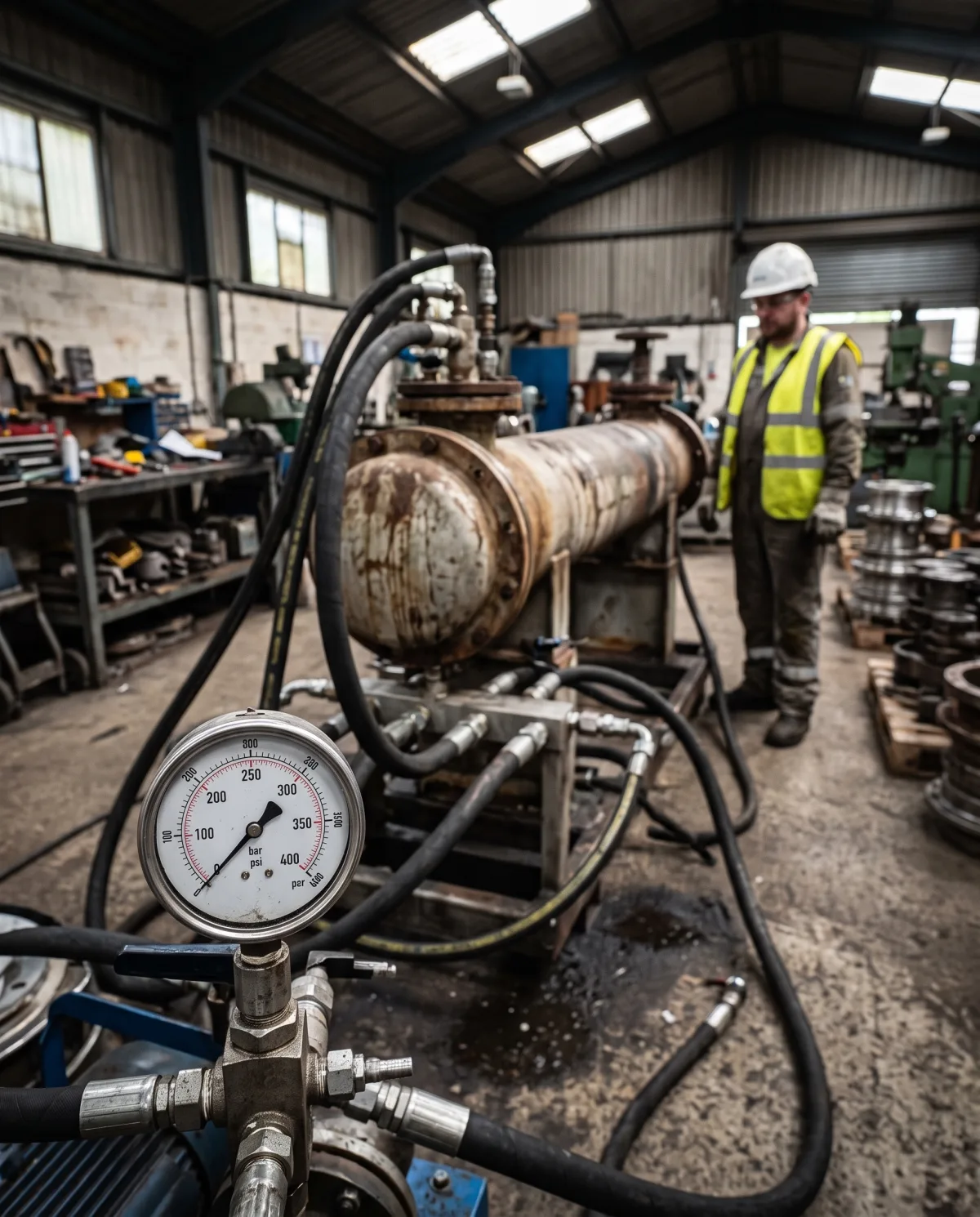
Heat exchanger leak testing
Heat exchanger leak testing finds the leak in a unit before it goes back to work. Send the nameplate and what has happened, and a specialist who works on that type will come back to you. Coverage is UK wide.
Tell us about your leak and pressure testing
Five answers, all from memory. The detail comes next, and it is optional.
See the privacy notice for how these details are handled.
Common problems that need leak and pressure testing
It has failed or is leaking
Fluids mixing, a leak at the unit, or one that will not hold pressure.
Emergency repair →Losing dutyPerformance has dropped
Higher pressure drop, a wider approach temperature, or a duty it no longer reaches.
Cleaning options →PlannedA service or shutdown is coming
Planned maintenance, an outage window, or a spare that needs to be ready.
Servicing options →UnsureNot sure what is wrong
Send the nameplate and what you have noticed. That is enough to get an answer.
Send the details →When heat exchanger leak testing is needed
Heat exchanger leak testing and pressure testing either find where a unit is leaking or prove that it is not. Which test is right depends on what a leak would cost you, and these are the reasons it is normally done.
- Product appearing in cooling water, or cooling water appearing in product
- Make up water consumption that has climbed with no visible leak
- Proving a repair before the unit goes back on line
- Establishing whether a suspect unit is sound, so it can be ruled in or out
- Certification after a repair, for the written scheme of examination
Leak and pressure testing methods
Send the details
The unit, the nameplate and what you are trying to prove. Finding a leak and certifying a repair are different tests.
The right test for the consequence
A hydrostatic test proves the pressure envelope and is what certification usually rests on. Helium testing finds leaks far smaller than that, which is what a food, pharmaceutical or high purity duty needs.
Each side separately
Shell and tube sides are tested independently. Testing both together can hide a leak between the circuits entirely, because the pressure is equal either side of it.
The record
What was tested, at what pressure and for how long. Where the unit sits under a written scheme of examination, that record is the point of the exercise.
Choosing the right test method
What the consequence of a leak is
A leak that costs make up water and a leak that puts glycol into a food product are not the same problem, and they do not justify the same test. The sensitivity should follow the consequence.
Test pressure against design pressure
Test pressure is set from the unit's design conditions and its nameplate. Testing above that damages the equipment, so an illegible or missing nameplate is a real obstacle rather than a formality.
Which side to test
Shell side and tube side are tested separately. Testing both together can hide a tube leak entirely, because the pressure is equal either side of the failure.
What the record has to show
If the test exists to satisfy a written scheme of examination under PSSR 2000, the record has to say what was tested, at what pressure, for how long, and by whom. The written scheme decides that before the test, not afterwards.
Leak and pressure testing questions
What is the difference between MAWP and design pressure?
Design pressure is the figure the exchanger was designed to, and maximum allowable working pressure is the highest pressure the finished unit is permitted to operate at in its current condition, which can be lower once corrosion allowance has been consumed. Both are on the nameplate and both matter, because test pressure is derived from them rather than from the operating pressure.
How is hydrotest pressure decided?
From the design pressure and the code the unit was built to, corrected for the temperature and the material rather than taken as a flat multiple. Testing to an assumed figure risks damaging equipment that is otherwise serviceable, which is why an illegible nameplate is a real obstacle.
Can you test without removing the exchanger?
Often, yes, if it can be isolated and drained and the channel can be opened. What in situ testing cannot do is inspect the bundle, so it will tell you the unit is leaking without telling you the state of the tubes that have not failed yet.
A hydrostatic test passed but the unit still leaks in service. Why?
Usually because the leak only opens under thermal load or under differential pressure the test did not reproduce, or because it is small enough to sit below what a hydrostatic test can resolve. Helium testing exists for exactly that case.
How is the test pressure decided?
From the design pressure on the nameplate and the code the unit was built to, not from the operating pressure. Testing to an assumed figure risks damaging equipment that is otherwise serviceable.