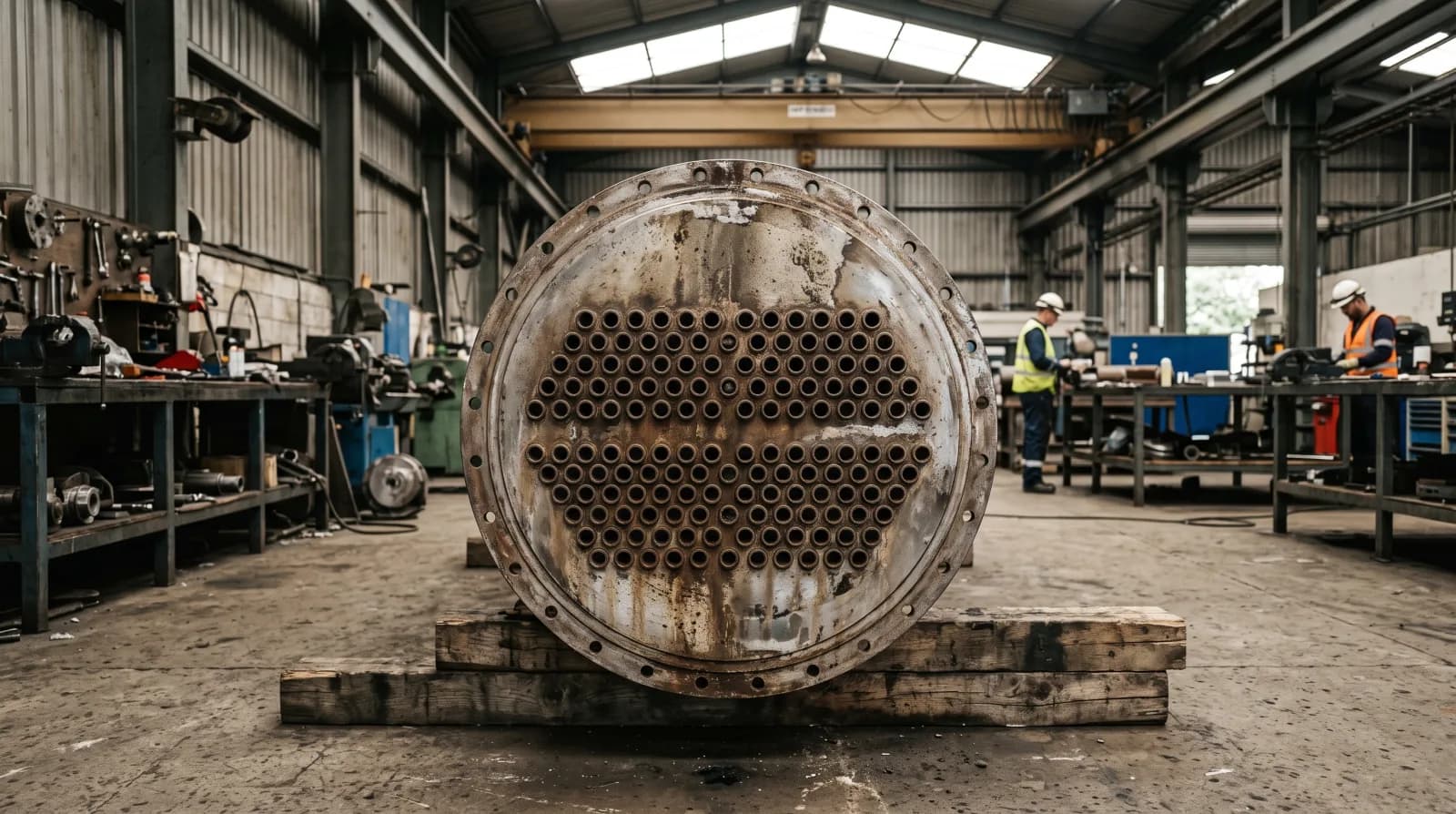
Heat exchanger retubing
Heat exchanger retubing replaces the whole tube bundle inside a sound shell. Send the nameplate and what has happened, and a specialist who works on that type will come back to you. Coverage is UK wide.
Tell us about your heat exchanger retubing
Five answers, all from memory. The detail comes next, and it is optional.
See the privacy notice for how these details are handled.
Common shell and tube problems
A tube is leaking
Fluid crossing between the shell and tube sides, from a tube or a tube to tubesheet joint.
Tube plugging →Losing dutyFouled tubes and rising pressure drop
Deposit inside the tubes or around the bundle, costing duty at the same flow.
Cleaning options →Plant downIt has failed or is leaking
Fluids mixing, a leak at the unit, or one that will not hold pressure.
Emergency repair →UnsureNot sure what is wrong
Send the nameplate and what you have noticed. That is enough to get an answer.
Send the details →Signs a tube bundle needs retubing
Heat exchanger retubing replaces the whole tube bundle rather than the tubes that have failed so far. It is the right call once individual repairs stop being economic, which usually shows up in one of these ways.
- Enough tubes have been plugged that the unit no longer meets its duty
- Eddy current or IRIS results show wall loss across the bundle rather than in a few tubes
- Repeat leaks in different tubes, which points at the bundle rather than at individual failures
- Tube material that has never suited the water chemistry or process fluid it is carrying
- A sound shell around a bundle that is not, which is the case where retubing is most economic
The heat exchanger retubing process
Send the details
The nameplate, the tube material if you know it, and whether the bundle can be withdrawn. Enough to establish whether a retube is realistic before anyone travels.
Assessment first
The bundle is inspected and the shell assessed, because retubing a sound shell is economic and retubing a corroded one is not.
The retube
Old tubes out, tubesheet holes cleaned back, new tubes fitted and sealed. Tube material can be changed at this point if the original never suited the duty.
Tested and returned
Pressure tested before it goes back, with the records the plant needs.
What affects the scope of a retube
Tube material
Carbon steel, stainless, duplex, admiralty brass, cupronickel and titanium all behave differently on cost, lead time and how they are joined. Retubing is the moment to correct a material that was wrong for the duty, and it is usually cheaper than doing it twice.
Fixed against removable bundle
A U-tube or floating head bundle comes out. A fixed tubesheet unit does not, so tubes are replaced in situ through the tubesheet, which is slower and limits what can be inspected.
Tube count, length and pitch
These set the labour more than anything else. A long, tightly pitched bundle takes considerably longer than the tube count alone suggests.
Whether the shell is worth keeping
Retubing a sound shell is economic. Retubing one with significant shell side corrosion is not, and that assessment belongs before the work is quoted rather than after it starts.
The written scheme of examination
Pressure systems in the UK sit under PSSR 2000, and a repair has to leave the unit in a state the competent person can certify against its written scheme. That is a constraint on the method, not paperwork added afterwards.
Heat exchanger retubing questions
Is retubing cheaper than a new heat exchanger?
Usually, where the shell is sound, because the shell, channels, nozzles and supports are the expensive fabrication and they are all being kept. It stops being true once the shell itself needs significant work, and the honest answer needs the unit inspected rather than guessed from a drawing.
How many tubes can be plugged before the unit needs retubing?
There is no universal figure, because it depends on the margin the exchanger was designed with. A unit specified with generous surface area tolerates a surprising number of plugged tubes. One running close to its duty does not. The number that matters is the thermal performance you are still getting, not the percentage plugged.
Can tubes be replaced individually instead?
Yes, and where only a handful have failed that is the sensible route. It stops being sensible when the failures are spread across the bundle, because each new tube then sits among tubes that are close to failing themselves.
Does the tube material have to match the original?
No, and matching it is sometimes the mistake. If the original material was wrong for the water chemistry or process fluid, a retube is the natural point to change it. The change has to be checked against the design conditions and the tubesheet, since not every material pairs safely with every tubesheet.