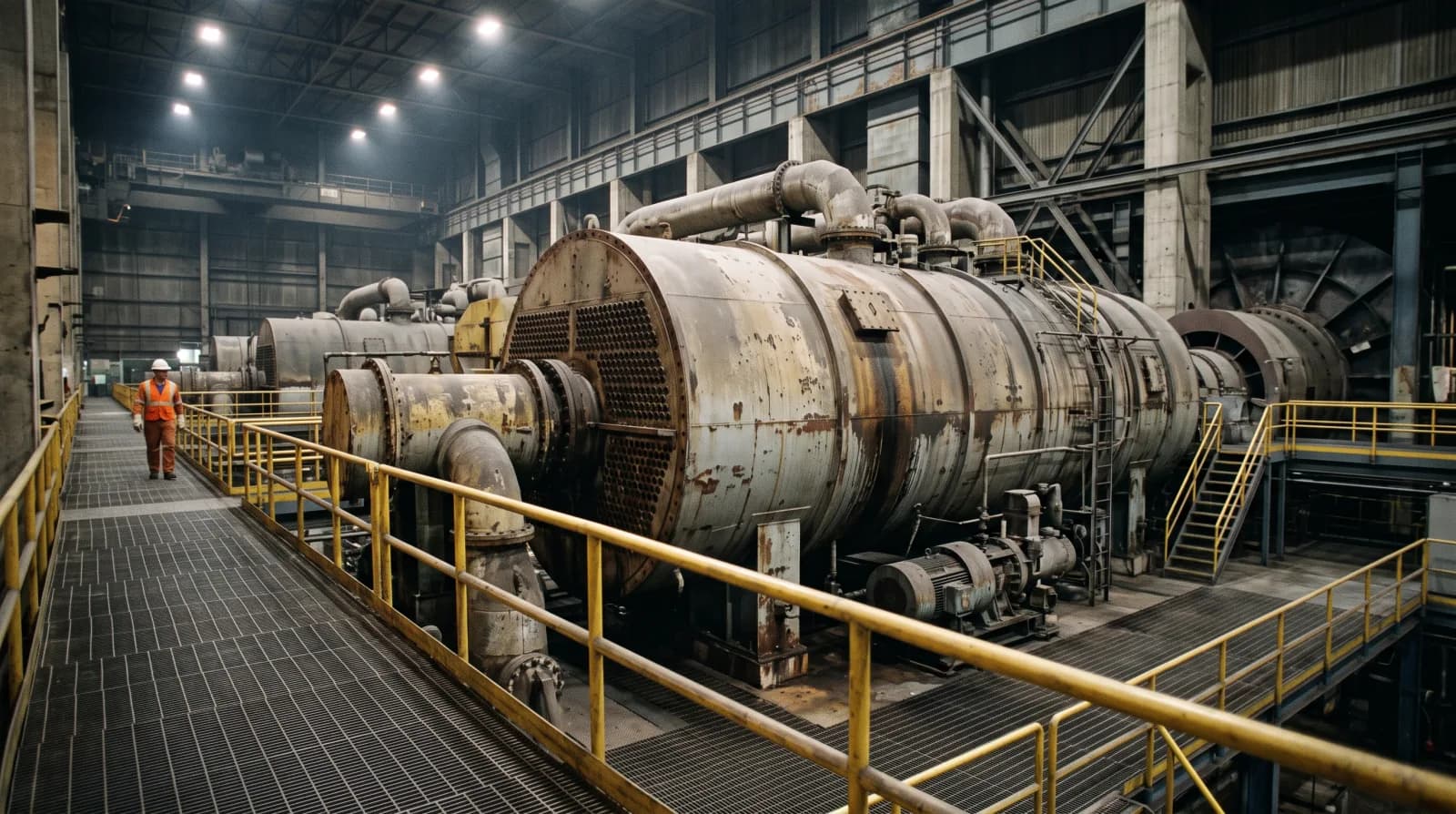
Condenser repairs
Condenser repairs recover lost vacuum and stop cooling water reaching the steam side. Send the nameplate and what has happened, and a specialist who works on that type will come back to you. Coverage is UK wide.
Tell us about your condenser repairs
Five answers, all from memory. The detail comes next, and it is optional.
See the privacy notice for how these details are handled.
Common condenser problems
Cooling water is getting in
A leaking tube contaminating the water and steam circuit, which needs finding and plugging.
Tube plugging →Losing dutyFouled tubes
Deposit or biofilm on the water side, raising back pressure and costing output.
Cleaning options →Plant downIt has failed or is leaking
Fluids mixing, a leak at the unit, or one that will not hold pressure.
Emergency repair →UnsureNot sure what is wrong
Send the nameplate and what you have noticed. That is enough to get an answer.
Send the details →What goes wrong with condensers
Condenser repairs cover surface and steam condensers, where a single leaking tube contaminates the water and steam circuit and lost vacuum shows up as lost output. These are the faults that bring a condenser in.
- Tube leaks and condensate contamination. The critical failure. Because the shell side is under vacuum, cooling water is drawn inward instead of steam being pushed out, and it contaminates the condensate. Conductivity in the condensate is what detects it, usually before anything else does.
- Air ingress. Air drawn in through joints, glands or the shell degrades the vacuum, which costs turbine output directly. Air ingress presents as poor vacuum with no tube leak, and finding it is a different search entirely.
- Tube side fouling and blockage. Silt, biological growth and debris from the cooling water source. Debris reduces flow and duty, and river or sea cooled plant sees it continuously.
- Inlet end erosion. Concentrated damage in the first part of the tube from turbulence and entrained debris, which is why inlet end protection or sleeving is common on condensers specifically.
- Waterbox and tubesheet corrosion. Attack on the waterbox lining, the tubesheet face and the tube ends, particularly on seawater or brackish cooling. Where cathodic protection is fitted, spent anodes are a common root cause.
Condenser repair options
- Locate and plug the leaking tubes
- Helium leak detection is the usual method on a condenser, because the vacuum makes it well suited and the tube count makes elimination impractical.
- Eddy current inspection
- Condenser tubing is usually non-ferrous, which suits eddy current well, and it is the practical way to assess thousands of tubes and trend them between outages.
- Retube
- Where wall loss is general. Retubing is also the point at which tube material gets reconsidered, since many older condensers carry a material chosen for a cooling water chemistry that has since changed.
- Waterbox repair and protection
- Lining repair, tubesheet cladding and renewal of cathodic protection, which is what stops the same corrosion returning after the tube work is done.
What to check before a condenser repair
- Poor vacuum is not always a tube leak. Air ingress produces the same symptom and needs a different search, so establishing which one you have comes before opening anything
- A condenser is under vacuum, so leaks draw water in. A conventional pressure test does not reproduce that condition, which is why helium testing is the standard approach
- Condensate conductivity is the earliest warning of a tube leak, and it is usually already being monitored, so the trend is often available before anyone goes looking
- Spent anodes are a common reason waterbox corrosion returns after a repair, and they are easy to leave off the scope
Condenser repairs questions
How is a condenser tube leak found?
Helium leak detection is the normal method. Helium is applied to the suspect area while the condenser is under vacuum, and it is drawn in and detected in the extracted gas. With thousands of tubes, elimination by plugging is not a realistic alternative.
The vacuum is poor but there is no condensate contamination. Why?
That pattern usually means air ingress rather than a tube leak: air being drawn in through joints, glands or the shell. Air ingress degrades vacuum and costs output, and it is found by a different search than a tube leak.
How many condenser tubes can be plugged?
The margin the condenser was designed with decides it, together with what plugging does to the vacuum, which is what actually costs output. The measure that matters is the vacuum you are still achieving, not a percentage of tubes.