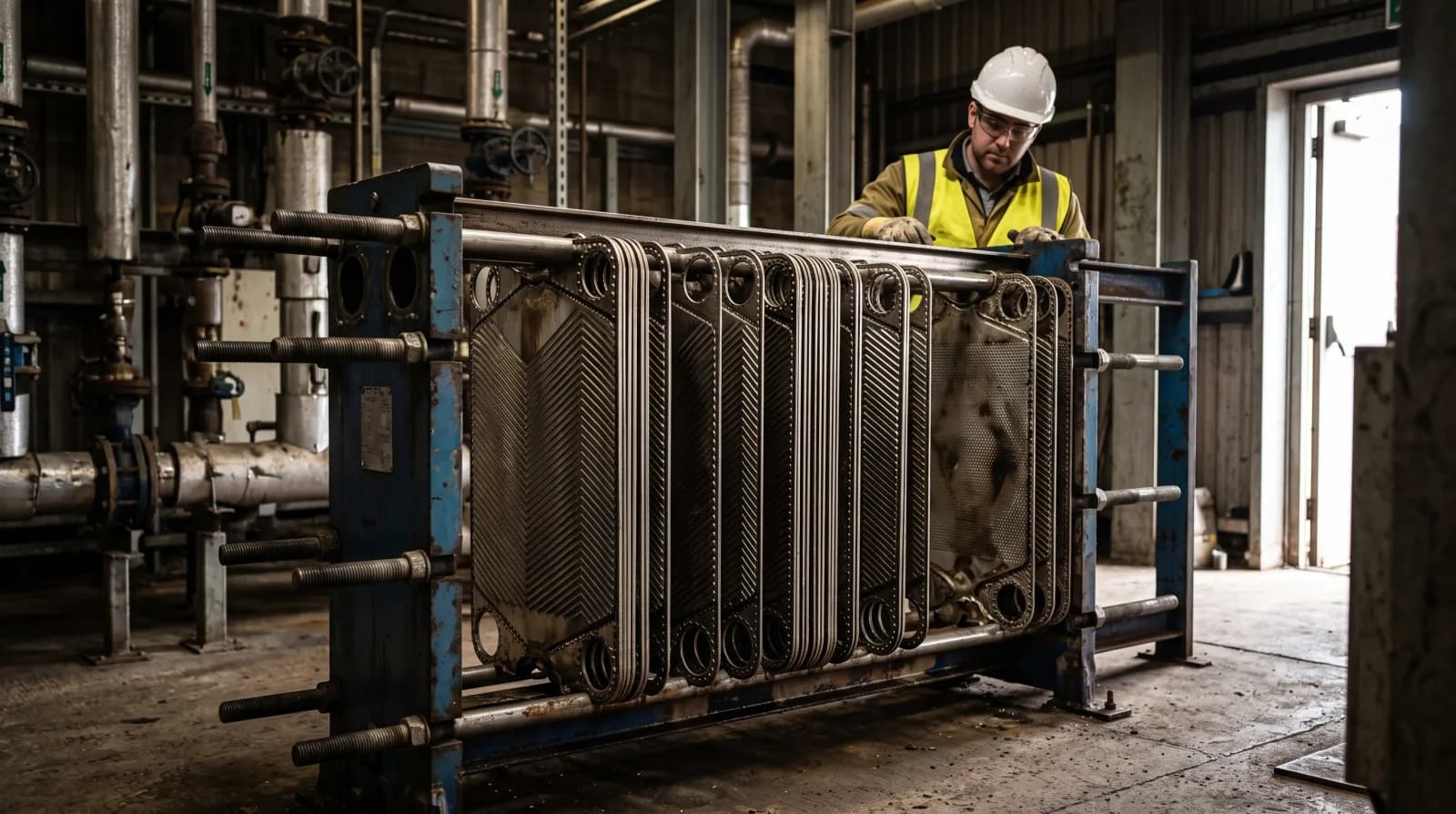
Plate heat exchanger repairs
Plate heat exchanger repairs fix leaking packs, cracked plates and worn gaskets. Send the nameplate and what has happened, and a specialist who works on that type will come back to you. Coverage is UK wide.
Tell us about your plate heat exchanger repairs
Five answers, all from memory. The detail comes next, and it is optional.
See the privacy notice for how these details are handled.
Common plate heat exchanger problems
Weeping at the pack
A leak along the edge of the plate pack, usually the gaskets rather than the plates.
Regasketing →Losing dutyPressure drop up, duty down
Fouling between the plates, widening the approach temperature and restricting flow.
Cleaning options →Plant downIt has failed or is leaking
Fluids mixing, a leak at the unit, or one that will not hold pressure.
Emergency repair →UnsureNot sure what is wrong
Send the nameplate and what you have noticed. That is enough to get an answer.
Send the details →Signs a plate heat exchanger needs repair
Plate heat exchanger repairs cover a pack that is leaking, mixing the two fluids or no longer holding pressure. Whether the fault is a gasket or a plate changes the job completely, and it is rarely obvious until the pack is opened.
- Weeping between the plates along the edge of the pack
- Cross contamination between the two fluids, which usually means a cracked plate rather than a gasket
- Approach temperature drifting and pressure drop climbing, both signs of fouling between the plates
- Gaskets that have gone hard, taken a set, or are being attacked by the process fluid
- A pack that has been tightened repeatedly and is now below its minimum plate pack dimension
The plate heat exchanger repair process
Send the details
The nameplate and what has happened. Whether fluids are mixing or the pack is weeping outward changes the repair entirely.
Strip, clean and inspect
The pack is opened and the plates cleaned so they can be examined. Cracks and pinholes are found at this stage, and they are the cause of fluids mixing.
Repair and rebuild
The gasket set is renewed, failed plates come out, and the pack is compressed back to its recorded dimension.
Tested and returned
Both sides tested independently, which is what proves nothing passes between the circuits.
What affects the outcome of a plate repair
Gasket material
Nitrile, EPDM, Viton and others each suit different fluids and temperature ranges. The wrong material fails quickly and takes the rebuild with it, so the gasket is specified against the duty.
Plate condition against plate cost
Plates are the expensive part. Where enough of them fail inspection, replacing the unit can beat rebuilding it, and that arithmetic should be done honestly before the work rather than after.
Plate availability
Plates and gaskets are model specific. Availability, and whether the model is still supported, is a real constraint on turnaround for older units.
What is actually fouling it
Scale, biofilm and product deposits need different cleaning. In food and dairy work the cleaning method also has to leave the plates fit to return to a food contact duty.
Plate heat exchanger repairs questions
How long does a plate heat exchanger last?
The frame and plates can last for decades on a mild duty, while the gaskets are a wearing part measured in years and driven by temperature and fluid rather than age. Plate condition at the last strip down predicts remaining life; the date on the nameplate does not.
Do plate heat exchangers fail?
They do, in three ways. Gaskets harden and leak outward, plates crack or perforate and let the two fluids mix, and fouling closes the channels and takes the duty away. The first two are repairs, the third is a clean.
What is the problem with plate heat exchangers?
The gaskets set the limits. They cap the pressure and temperature the unit can take and they are a consumable, so a gasketed plate exchanger needs opening periodically in a way a welded unit does not. In exchange it is compact, efficient at a close approach temperature, and can be opened for inspection.
Can you patch a hole in a heat exchanger?
Not on a plate. A cracked or perforated plate is replaced, because a patched plate leaves the cross contamination that brought the unit in. On tubular units a failed tube can be plugged or sleeved, which is a different thing from patching.
Can you fix a broken heat exchanger?
Most gasketed plate and tubular units can be repaired, and the question is whether it is economic. What decides that is the condition of the frame or shell, since that is the expensive part and the one that is being kept.
Can a cracked plate be repaired?
No. A cracked plate is replaced. A cracked plate is replaced. Dye penetrant testing finds the crack, and the plate comes out of the pack.
Why does the pack leak again after tightening?
Tightening a leaking pack is a short term fix that compresses gaskets already at the end of their life, and every tightening takes the pack closer to its minimum dimension. Below that dimension it cannot seal at all, and the plates themselves start to deform.
Do all the gaskets get replaced, or just the leaking ones?
All of them. A gasket set is renewed complete, because replacing one seal in an aged set brings the unit back within months.
Can plates be cleaned in place?
Clean in place is normal for routine duty and will hold fouling back. It does not remove hard scale or established biofilm, and it cannot inspect a plate for cracks, which is the part that stops cross contamination.