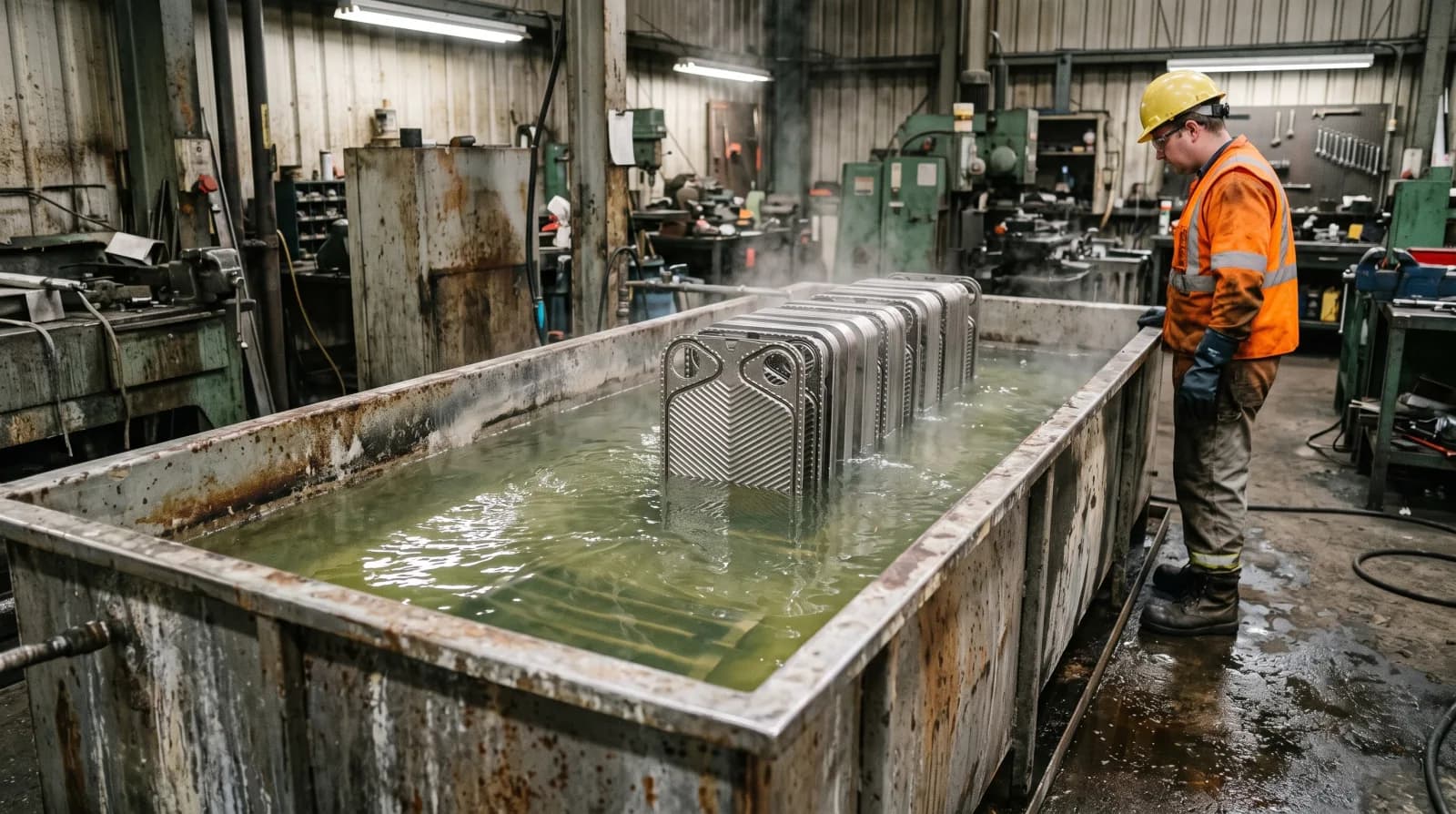
Plate heat exchanger cleaning
Plate heat exchanger cleaning clears the deposit blocking the channels between the plates. Send the nameplate and what has happened, and a specialist who works on that type will come back to you. Coverage is UK wide.
Tell us about your plate heat exchanger cleaning
Five answers, all from memory. The detail comes next, and it is optional.
See the privacy notice for how these details are handled.
Common plate heat exchanger problems
Weeping at the pack
A leak along the edge of the plate pack, usually the gaskets rather than the plates.
Regasketing →Cross contaminationThe two fluids are mixing
Product or utility appearing on the wrong side, which normally means a cracked plate.
Repair options →Plant downIt has failed or is leaking
Fluids mixing, a leak at the unit, or one that will not hold pressure.
Emergency repair →UnsureNot sure what is wrong
Send the nameplate and what you have noticed. That is enough to get an answer.
Send the details →Signs a plate heat exchanger needs cleaning
Plate heat exchanger cleaning restores duty lost to fouling between the plates. A strip clean is also the only point at which the plates can be inspected, which is why cleaning and plate condition are one conversation on a plate unit.
- Approach temperature widening, so the unit no longer reaches the duty it was sized for
- Pressure drop climbing across the exchanger
- Flow falling with no change to the pump
- A chiller, boiler or cooling tower working harder to cover the shortfall, which is where the energy cost actually shows up
- Cleaning intervals getting shorter, which points at something upstream rather than at the exchanger
Plate heat exchanger cleaning methods
Send the details
The nameplate, the fluids and what performance has done. On product duties the fluids also decide what cleaning is permissible.
Clean in place, or strip clean
Cleaning in place circulates chemistry through the assembled pack and holds routine fouling back. It cannot reach a heavily blocked channel, and it cannot inspect a plate. A strip clean removes the plates and cleans the chevron corrugations individually, which is where deposit lodges. A strip clean does both.
Inspect while the plates are out
With the pack open, plates are checked for cracks and pinholes. Dye penetrant testing under ultraviolet light is the only point at which plate condition is established.
Rebuild and prove it
Plates back in order, pack tightened to dimension, and the result measured against the approach temperature and pressure drop that justified the work.
Choosing between cleaning in place and a strip clean
What is actually fouling it
Scale, biofilm, product deposit and corrosion product need different chemistry. Cleaning before identifying the deposit is how plates get damaged and how the fouling returns on the same schedule.
Plate material and thickness
Chemistry safe on stainless can attack titanium coatings or thin plates, and plates are the expensive part of the unit. The plate material picks the method.
Food, dairy and potable duties
Where the exchanger touches product or drinking water, the chemistry and the rinse have to leave it fit to go back on that duty. That genuinely narrows the options, and it is a question for the enquiry stage, not the workshop.
Why it fouled in the first place
Cleaning treats the symptom. If water treatment, velocity or a temperature profile caused it, the deposit comes back. A cleaning interval that keeps shortening is the clearest signal that something upstream needs attention.
Plate heat exchanger cleaning questions
What chemical is used to clean a plate heat exchanger?
It depends on the deposit and the plate material. Scale is usually removed with an acidic cleaner, organic and protein deposits with an alkaline one, and a unit on a food duty has to be left fit to return to product service. Identifying the deposit comes first, because the wrong chemistry attacks the plate.
Can plate heat exchangers be cleaned?
Yes. Cleaning in place circulates chemistry through the assembled unit, and a strip clean removes the plates and cleans them individually in heated tanks. Only the second one lets the plates be inspected, which is why a strip clean answers both questions at once.
Are plate heat exchangers easy to clean?
Easier than most tubular units, because the pack is designed to be opened. Gasketed plates come out individually. Brazed units cannot be opened at all and are cleaned chemically or not at all.
Is clean in place enough?
For routine maintenance on a duty that does not foul hard, often yes. It is not enough when the unit is already well down on performance, when the fouling is hard scale or established biofilm, or when you need to know the condition of the plates. CIP cannot inspect anything.
How often should the plates be cleaned?
When the numbers say so. Trending approach temperature and pressure drop gives a genuine trigger; a fixed interval tends to be either too early or too late.
Can cleaning damage the plates?
Yes, if the method does not match the material. Wrong chemistry attacks the plate, and aggressive mechanical cleaning damages the pressing that does the heat transfer. It is one reason a workshop tank clean is gentler than field methods, not harsher.
Will cleaning stop a leak?
No. Cleaning restores performance. A leak is a gasket or a cracked plate, and it needs a repair, though a clean is very often what makes the crack visible in the first place.