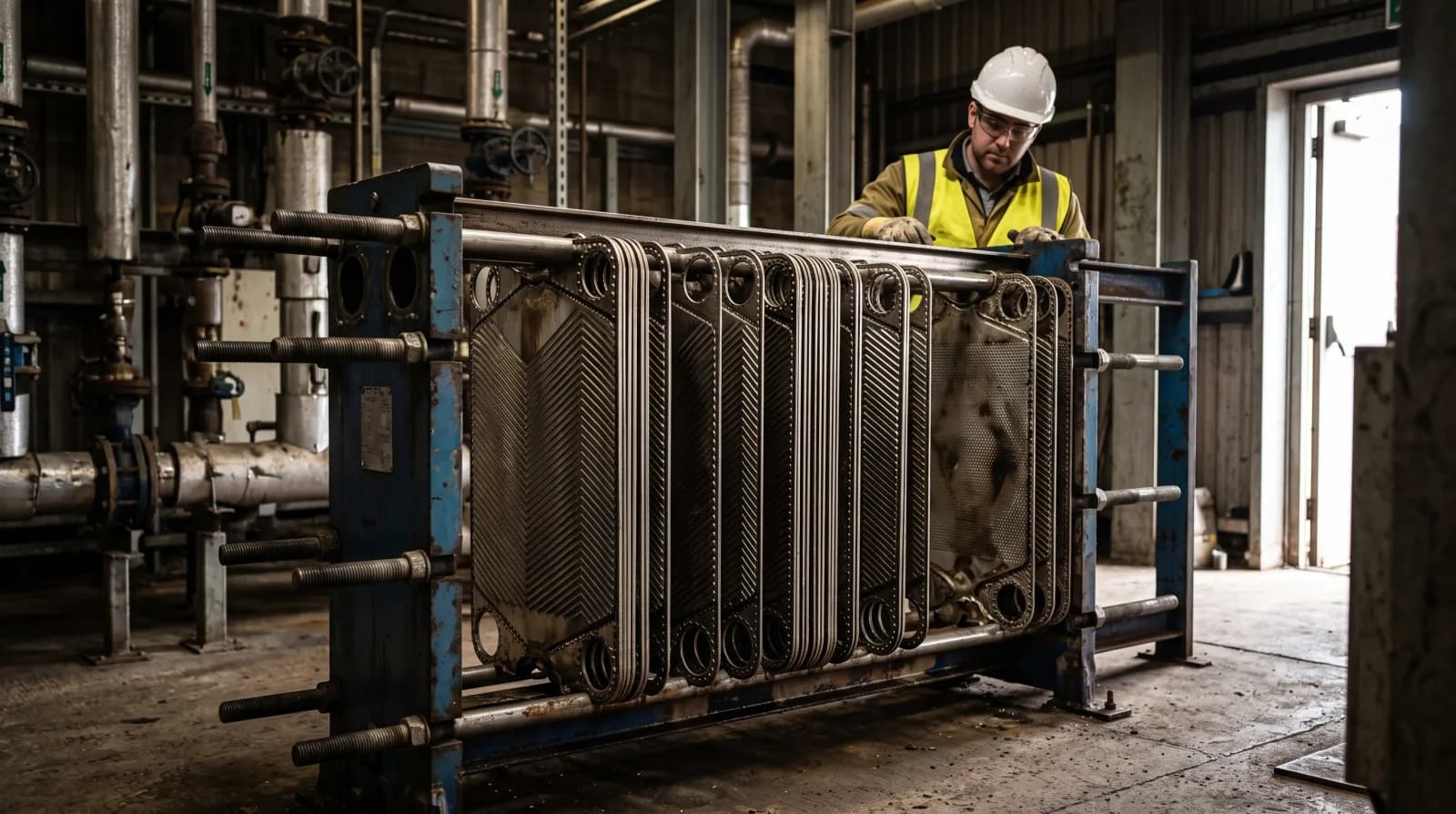
Heat exchanger leaking
Heat exchanger leaking means a failed gasket, a cracked plate or a split tube. The cause decides the fix, and it is rarely obvious from outside. Send the nameplate and what you have noticed, and a specialist will come back to you.
Tell us about your heat exchanger leaking
Five answers, all from memory. The detail comes next, and it is optional.
See the privacy notice for how these details are handled.
What causes a heat exchanger to leak
A heat exchanger leaking is either losing fluid to the outside or passing it between the two circuits, and those are different faults with different repairs. Which one you have is the first thing worth establishing.
- Gasket failure on a plate unit
- The most common external leak on a plate heat exchanger. Gaskets harden and take a set with age, temperature and the fluid they carry. Gasket failure usually shows as weeping along the edge of the pack.
- A cracked or perforated plate
- A cracked plate is the usual cause when the two fluids mix instead of leaking out. A crack cannot be seen with the pack assembled, and tightening does not fix it.
- A failed tube or tube joint
- On a shell and tube unit, fluid crossing between circuits normally means a tube or the joint where it meets the tubesheet. Which of the two it is changes the repair.
- Corrosion of the shell, channel or frame
- Less common and more serious, because it is the pressure envelope rather than the internals. Shell corrosion needs assessment before the unit goes back into service.
- Over-tightening
- A plate pack tightened repeatedly to stop a weep eventually drops below the dimension at which it can seal at all, and the plates begin to deform.
What to do now
- Note where the leak shows and whether it is fluid escaping or the two fluids mixing, because that single fact changes the likely cause
- Record temperatures, pressures and any make-up water figures before the plant is drained, since that information disappears once it is
- Photograph the nameplate. It sets the parts and the test pressure and it is the quickest way to a useful answer
- Resist tightening a plate pack that is already leaking. It rarely holds and it can turn a gasket job into a plate replacement
Heat exchanger leaking questions
Can a leaking heat exchanger keep running?
Sometimes, and it depends entirely on what is leaking and where it is going. An external drip on a heating circuit is a different matter from cooling water reaching a product. The plant makes that judgement, not a web page.
How is the source of a leak found?
By pressure testing each side separately. Testing both together can hide a leak between the circuits, because the pressure is equal either side of the failure.
Is a leaking heat exchanger worth repairing?
Usually, where the shell or frame is sound, because that is the expensive part of the unit and it is being kept. The assessment settles it.