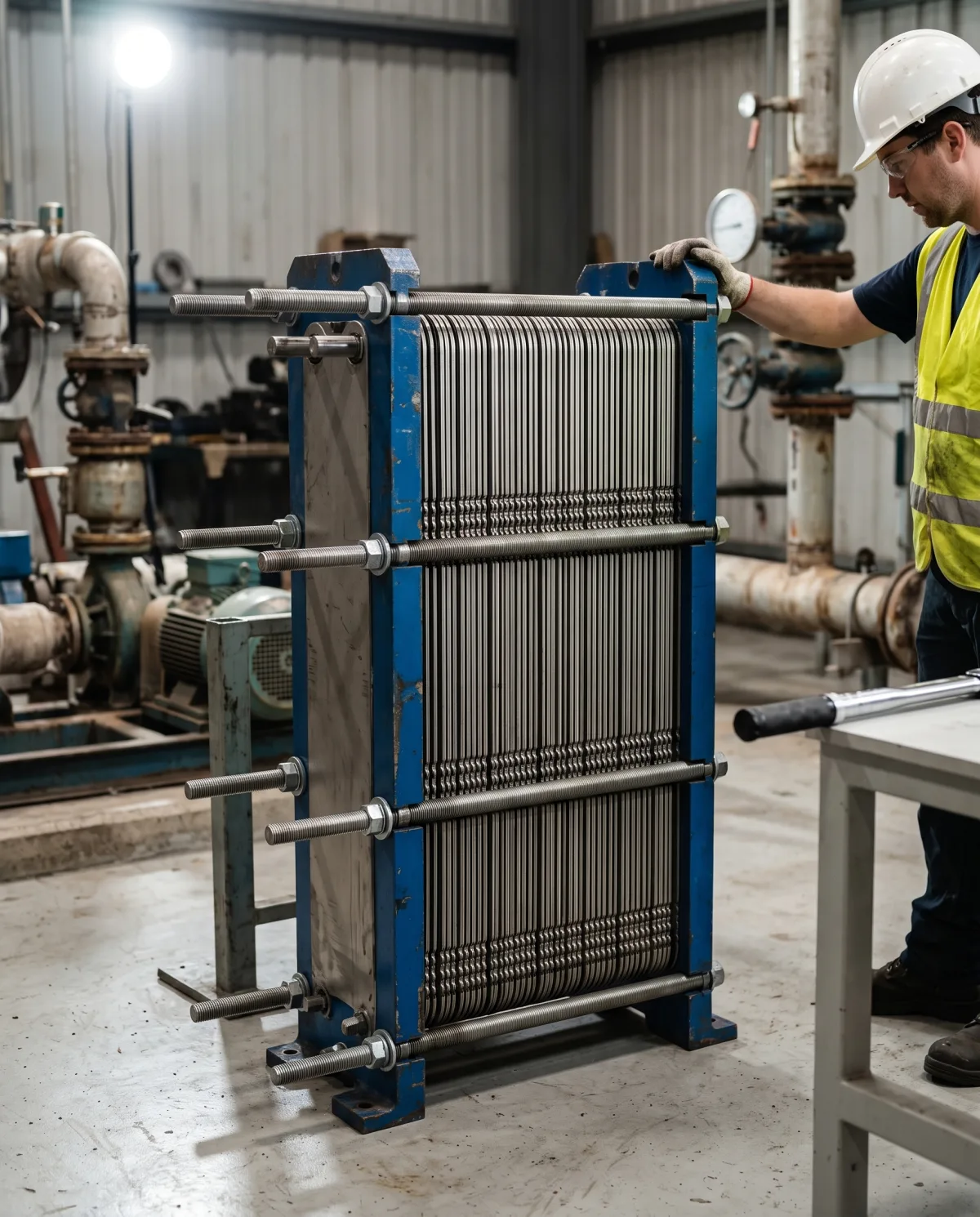
Heat exchanger refurbishment
Heat exchanger refurbishment returns a worn unit to a known, tested condition. Send the nameplate and what has happened, and a specialist who works on that type will come back to you. Coverage is UK wide.
Tell us about your heat exchanger refurbishment
Five answers, all from memory. The detail comes next, and it is optional.
See the privacy notice for how these details are handled.
Common problems that need heat exchanger refurbishment
It has failed or is leaking
Fluids mixing, a leak at the unit, or one that will not hold pressure.
Emergency repair →Losing dutyPerformance has dropped
Higher pressure drop, a wider approach temperature, or a duty it no longer reaches.
Cleaning options →PlannedA service or shutdown is coming
Planned maintenance, an outage window, or a spare that needs to be ready.
Servicing options →UnsureNot sure what is wrong
Send the nameplate and what you have noticed. That is enough to get an answer.
Send the details →When heat exchanger refurbishment is worthwhile
Heat exchanger refurbishment returns a unit to a known condition rather than fixing the one fault that stopped it. It covers what reconditioning and overhaul describe, and it is usually planned rather than reactive. These are the cases that call for it.
- A unit with a history of repeated small failures rather than one clear fault
- Plant coming out for a planned shutdown, where the outage is the constraint rather than the work
- A spare or standby unit that needs to be genuinely ready rather than nominally available
- Equipment inherited with an unknown history and no recent inspection record
- Corrosion on the shell, channels or nozzles as well as on the tubes
What heat exchanger refurbishment includes
Send the details
The unit, its history if there is one, and what has been going wrong. Refurbishment is usually planned, so the window matters as much as the fault.
Strip, clean and assess
The unit comes apart and is cleaned, then everything is inspected: tubes or plates, and the shell, channels and covers around them.
The scope, then the work
What has to be done now and what can wait is agreed before the work rather than discovered during it.
Tested and returned
Pressure tested to the design conditions, with a report on what was found and what to expect next time.
What affects the scope of a refurbishment
What the inspection finds
A refurbishment quoted firm before the unit is opened is a guess. The realistic approach is an inspection first, then a scope, which is why the assessment is worth treating as its own stage.
Shutdown windows
Most of this work is governed by an outage. Whether the unit is repaired in situ or exchanged for a spare and refurbished afterwards is a planning decision more than a technical one.
Whether a spare exists
Having a refurbished spare turns a breakdown into a swap. Not having one turns it into a shutdown, and that is worth costing honestly against the price of holding one.
Certification requirements
PSSR 2000 governs pressure systems in service, and repairs have to leave the unit certifiable against its written scheme of examination. What the competent person needs is decided at the start, not at the end.
Heat exchanger refurbishment questions
How long does a refurbishment take?
It depends on what the strip down finds, on tube and plate lead times, and on whether the pressure envelope needs weld repair. Any duration given before the unit is opened is an estimate. What can be fixed in advance is the inspection stage, and that is the point at which a real programme becomes possible.
Is a refurbished exchanger as good as new?
For most duties, a unit with a sound pressure envelope, new tubes or plates, new gaskets and a current pressure test is fit for its design conditions. What it does not do is change the design, so a unit that was undersized stays undersized.
Can it be done on site?
Cleaning, plugging and some plate work can be. A full strip down, NDT and weld repair generally needs a workshop, and moving the unit is usually cheaper than setting up equivalent facilities on site.