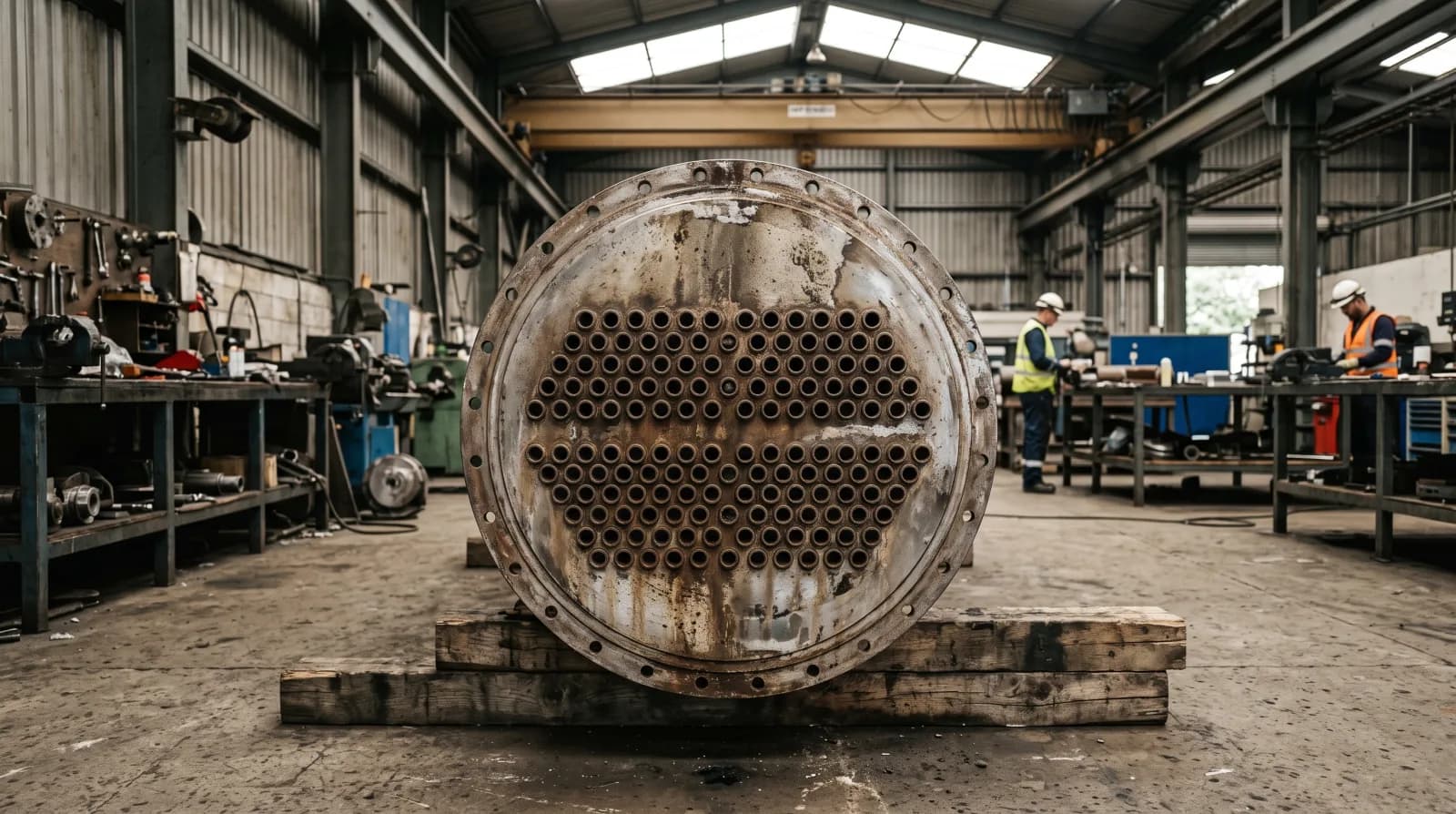
Shell and tube heat exchanger repairs
Shell and tube heat exchanger repairs fix leaking tubes, worn bundles and corroded shells. Send the nameplate and what has happened, and a specialist who works on that type will come back to you. Coverage is UK wide.
Tell us about your shell and tube heat exchanger repairs
Five answers, all from memory. The detail comes next, and it is optional.
See the privacy notice for how these details are handled.
Common shell and tube problems
A tube is leaking
Fluid crossing between the shell and tube sides, from a tube or a tube to tubesheet joint.
Tube plugging →Bundle conditionWall loss across the bundle
Repeat failures in different tubes, or a plugged tube count that keeps rising.
Retubing →Losing dutyFouled tubes and rising pressure drop
Deposit inside the tubes or around the bundle, costing duty at the same flow.
Cleaning options →UnsureNot sure what is wrong
Send the nameplate and what you have noticed. That is enough to get an answer.
Send the details →What goes wrong with shell and tube units
Shell and tube heat exchanger repairs cover tube failures, tubesheet and channel corrosion, and the decision between plugging, retubing and replacing. Most failures come down to one of the faults below, and which one you have changes the repair entirely.
- Tube wall loss. General thinning from corrosion, or localised pitting. It is the most common reason a unit comes out, and it is the one an inspection can measure and trend rather than discover at failure.
- Inlet end erosion. Damage concentrated in the first few inches of tube where flow is turbulent and anything entrained hits hardest. Failures clustered at the inlet end point here rather than at general corrosion, and sleeving is often the answer instead of retubing.
- Vibration damage. Tubes wearing where they pass through baffles, caused by flow induced vibration. Fretting shows as thinning at the baffle positions specifically, which is why the tubesheet map matters as much as the total wall loss.
- Tube to tubesheet joint leakage. The expanded joint relaxing, or the seal weld cracking. A joint leaks without the tube itself being damaged, which is why a pressure test that says the unit is passing does not by itself say the tubes are worn out.
- Shell, channel and nozzle corrosion. The part that decides whether the unit is worth repairing. A sound shell around a worn bundle is an economic retube. A corroded shell usually is not.
Shell and tube repair options
- Plug the failed tubes
- Fastest route back on line, done through the open channel without withdrawing the bundle. Suits a small number of failures in a bundle that is otherwise sound.
- Retube
- Full bundle replacement where wall loss is general rather than local, or where the original tube material never suited the duty. The natural point to change metallurgy.
- Repair the pressure envelope
- Weld repair to shell, channels and nozzles, to qualified procedures, with the result certifiable against the unit's written scheme of examination.
- Inspect and trend
- Eddy current for non-ferrous tubes, IRIS or remote field for ferrous. One inspection gives condition, two give the rate of loss, and the rate is what you can plan around.
What to check before a shell and tube repair
- Fixed tubesheet units cannot have the bundle withdrawn, so the shell side cannot be cleaned mechanically and tube replacement is done in situ. Establish which construction you have before planning anything
- A missing or illegible nameplate makes it hard to set a test pressure, which stalls the job at the last stage rather than the first
- Plugging both ends of a tube with liquid still inside creates a sealed vessel. The tube is pierced or drained first, or the plug is welded to the tubesheet
- The thermal duty you are still getting matters more than the percentage of tubes plugged, because it depends entirely on the margin the unit was designed with
Shell and tube heat exchanger repairs questions
Can you weld a cracked heat exchanger?
Weld repair to a shell, channel or nozzle is routine work, carried out to a qualified procedure, and on a pressure system it has to leave the unit certifiable against its written scheme of examination. Plates in a plate pack are not weld repaired, they are replaced.
What is tube rupture?
A tube failing completely rather than developing a small leak, which puts the two circuits in direct communication at full pressure. Pressure relief and the design conditions on the low pressure side exist to cover that failure mode.
What are the two sides of a heat exchanger called?
The tube side and the shell side. Fluid inside the tubes is on the tube side, fluid around them inside the shell is on the shell side, and they are tested separately for exactly that reason.
How do I know whether to plug, retube or replace?
Where the failures are, and what condition the shell is in. A few failures in a sound bundle means plugging. General wall loss across the bundle with a sound shell means retubing. A corroded shell usually means replacement, because you would be spending the cost of a retube on a unit that fails elsewhere shortly afterwards.
Can a shell and tube exchanger be repaired in place?
Plugging, cleaning and inspection are all done in place through the open channel. Retubing, weld repair and anything needing the bundle out generally means a workshop, and moving the unit is usually cheaper than recreating a workshop around it.
What is the difference between fixed tubesheet, U-tube and floating head?
How the bundle is fixed at each end, and whether it can come out. A fixed tubesheet unit is welded at both ends and the bundle stays put. U-tube and floating head designs allow for thermal expansion and let the bundle be withdrawn, which makes them considerably easier to clean and repair.