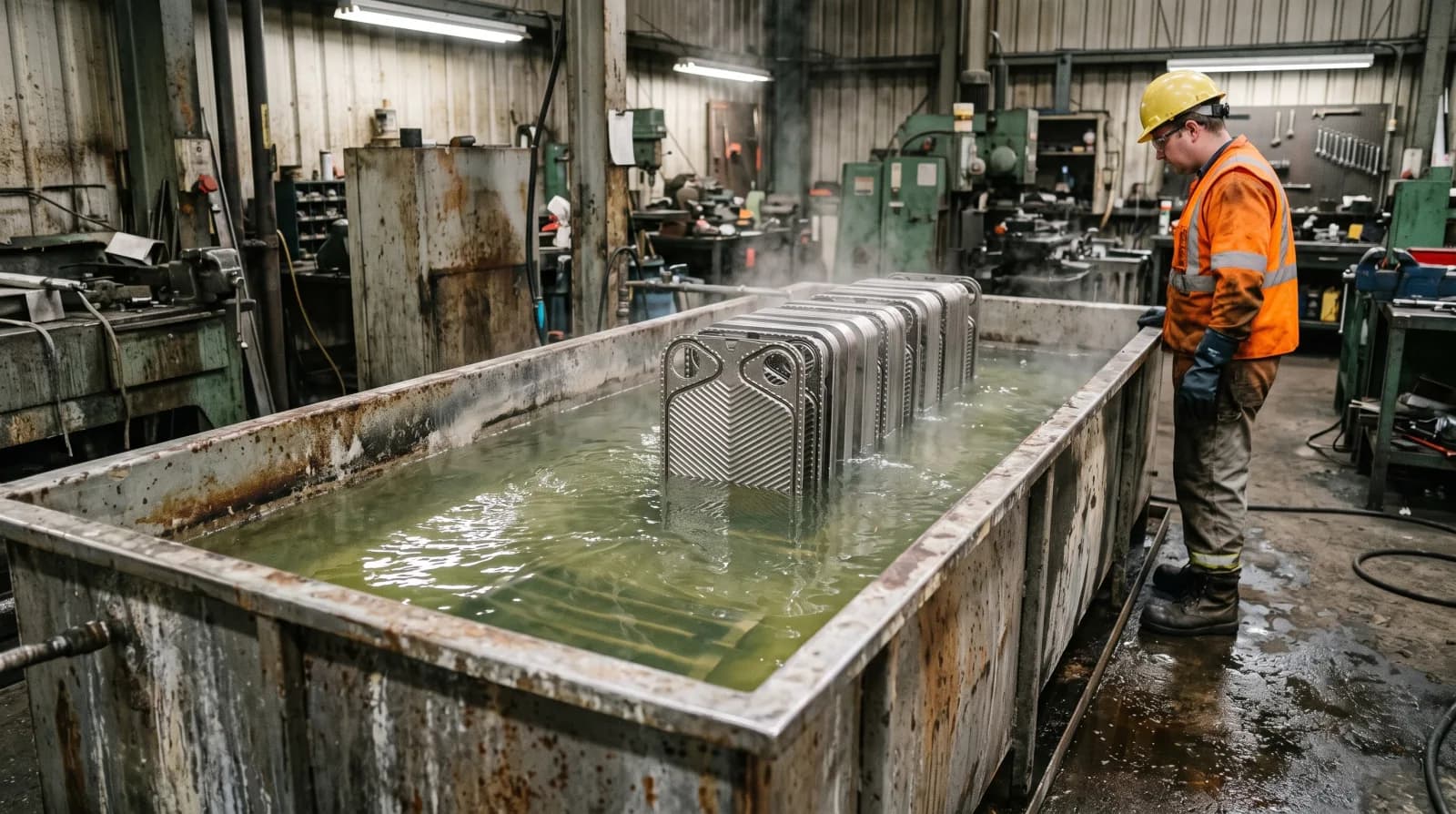
Blocked heat exchanger
Blocked heat exchanger restricts flow and drives the pressure drop up. The cause decides the fix, and it is rarely obvious from outside. Send the nameplate and what you have noticed, and a specialist will come back to you.
Tell us about your blocked heat exchanger
Five answers, all from memory. The detail comes next, and it is optional.
See the privacy notice for how these details are handled.
What blocks a heat exchanger
A blocked heat exchanger shows as pressure drop climbing and flow falling, and the blockage is almost always deposit rather than an object. What the deposit is decides how it comes out.
- Scale
- Hard mineral deposit from the water side, and the most common cause on heating and cooling duties. Scale builds where the surface is hottest.
- Product or process deposit
- Anything the process carries that bakes, sets or settles on the surface. Common in food, brewing and chemical duties.
- Biofilm
- Growth in cooling water systems, particularly where water sits still. Biofilm insulates the surface as well as restricting flow.
- Corrosion product and debris
- Rust, scale carried in from elsewhere in the system, and occasionally material that has come loose upstream and lodged in a port or tube end.
What to check first
- Compare the pressure drop across the unit with what it was when it was clean, since that is the measurement that proves a blockage rather than a pump problem
- Check the strainers and filters upstream before assuming the exchanger is at fault
- Note whether the restriction built up gradually or appeared suddenly, because sudden usually means debris and gradual usually means deposit
- Have the nameplate and the fluids on both sides to hand, as they decide which cleaning method is safe
Blocked heat exchanger questions
How do I know if my plate heat exchanger is blocked?
Compare the pressure drop across each side against the figure when it was clean, at the same flow. A blocked plate pack shows a rising pressure drop and a falling flow while the pump is unchanged. Temperature is the second check: a blocked unit stops reaching its approach temperature.
How do you flush a heat exchanger?
Circulated chemical cleaning is the usual method for a unit that stays in place, with the chemistry chosen for the deposit and checked against the plate or tube material. Flushing shifts loose debris and soft deposit; hard scale and established biofilm need the unit opened.
Can you unblock a heat exchanger?
Usually. Circulated chemical cleaning clears many deposits without opening the unit, and hard scale or debris needs it opened for jetting or mechanical cleaning. Which applies depends on the deposit, which is why identifying it comes first.
Can a blocked heat exchanger be cleaned in place?
Often, where the deposit responds to circulated chemistry and the pipework allows it. Hard scale, established biofilm and debris usually need the unit opened, and a unit cleaned in place cannot be inspected while it is closed.
Will cleaning restore the original performance?
Usually most of it, if the surfaces are undamaged. The check is not that the unit looks clean, it is whether the pressure drop and approach temperature have returned to where they were.
How often will it block again?
The cause decides that. If the water treatment, the flow rate or the temperature profile caused the deposit, it returns on the same schedule until one of those changes.