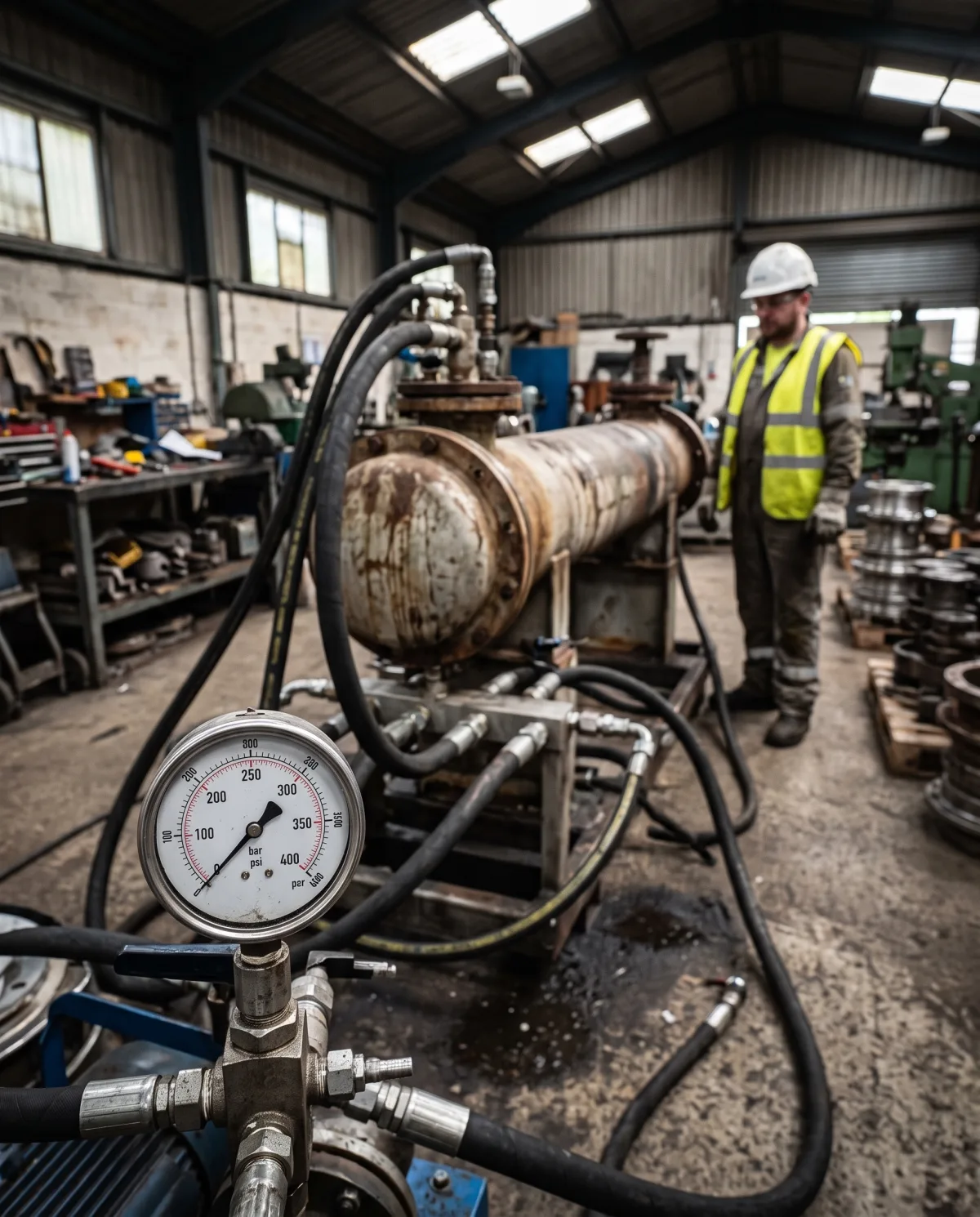
Design pressure, MAWP and test pressure explained
Design pressure, MAWP and test pressure decide what a unit may run at and be tested to. This guide sets out what the decision rests on and what to gather before you make it.
Tell us about your repair or service
Five answers, all from memory. The detail comes next, and it is optional.
See the privacy notice for how these details are handled.
Common heat exchanger problems
It has failed or is leaking
Fluids mixing, a leak at the unit, or one that will not hold pressure.
Emergency repair →Losing dutyPerformance has dropped
Higher pressure drop, a wider approach temperature, or a duty it no longer reaches.
Cleaning options →PlannedA service or shutdown is coming
Planned maintenance, an outage window, or a spare that needs to be ready.
Servicing options →UnsureNot sure what is wrong
Send the nameplate and what you have noticed. That is enough to get an answer.
Send the details →The short answer
Design pressure is what the unit was built for, MAWP is what it may run at now, and test pressure is derived from those and the construction code. Operating pressure is never the basis for a test figure.
All of it starts at the nameplate, which is why a photograph of it is worth more than any description of the fault. Where the unit is part of a pressure system, the written scheme of examination governs the repair as well as the paperwork.
For anyone commissioning a repair, a pressure test or an examination and needing to know which figure governs what, particularly where the unit sits under a written scheme of examination.
The three figures, and what each one governs
Design pressure is the pressure the exchanger was designed and calculated to, at a stated design temperature. It is a property of the original design rather than of the unit as it stands today.
Maximum allowable working pressure, usually written MAWP, is the highest pressure the finished unit is permitted to operate at, in its present condition, at a stated temperature. It can be lower than the design pressure once corrosion allowance has been consumed, which is one reason inspection findings matter beyond the immediate repair.
Test pressure is the pressure a unit is subjected to during a hydrostatic test to prove the pressure envelope. It is derived from design pressure or MAWP and the code the unit was built to, corrected for temperature and material, rather than being a flat multiple of the operating pressure.
- Design pressure
- What it was built for. Fixed at design, stated on the nameplate.
- MAWP
- What it may run at now. Can fall over the life of the unit as material is lost.
- Test pressure
- What it is proved at, derived from the above and the construction code.
- Operating pressure
- What it actually sees in service. Never the basis for a test figure.
Why the nameplate decides the repair
These figures live on the nameplate, along with the make, model, serial number and design temperature. That is why a photograph of the plate is the single most useful thing to send with an enquiry: it sets the parts, the materials and the test regime in one go.
Where the nameplate is missing or illegible, the figures have to be re-established from drawings, the original data sheet or the manufacturer's records before the unit can be tested. That is a real obstacle rather than a formality, because testing to an assumed figure risks damaging serviceable equipment, and testing too low proves nothing.
Temperature and pressure limits on plate units
On a gasketed plate heat exchanger the gasket material usually sets the working limit rather than the plates. An elastomer that suits a mild heating duty will not suit a high temperature one, and the wrong material fails quickly whatever the plate is rated for.
This is why there is no general figure worth quoting for the temperature or pressure a plate heat exchanger will take. The answer is the unit's own design conditions, narrowed further by the gasket specification, both of which are established from the nameplate and the model.
Where PSSR 2000 comes in
Where an exchanger forms part of a pressure system in the UK, the Pressure Systems Safety Regulations 2000 apply, and examination is governed by a written scheme of examination drawn up or certified by a competent person.
Repair, modification and re-test all sit inside that scheme. What the competent person requires is therefore settled before the method is chosen, not written up afterwards, and the test record has to state what was tested, at what pressure, for how long and by whom.
The Pressure Equipment (Safety) Regulations 2016 cover equipment as supplied rather than in service. Whether a particular repair counts as a modification under them is a question worth settling before work starts.
Send an enquiry
Five answers to start, and the detail after. The enquiry is sent as soon as you have given the first five, so nothing is lost if you stop there.
What to copy off it
Make, model and serial number, design pressure and temperature, test pressure and year of manufacture. A photograph of the plate is quicker than typing it out.
Tell us about your repair or service
Five answers, all from memory. The detail comes next, and it is optional.
See the privacy notice for how these details are handled.