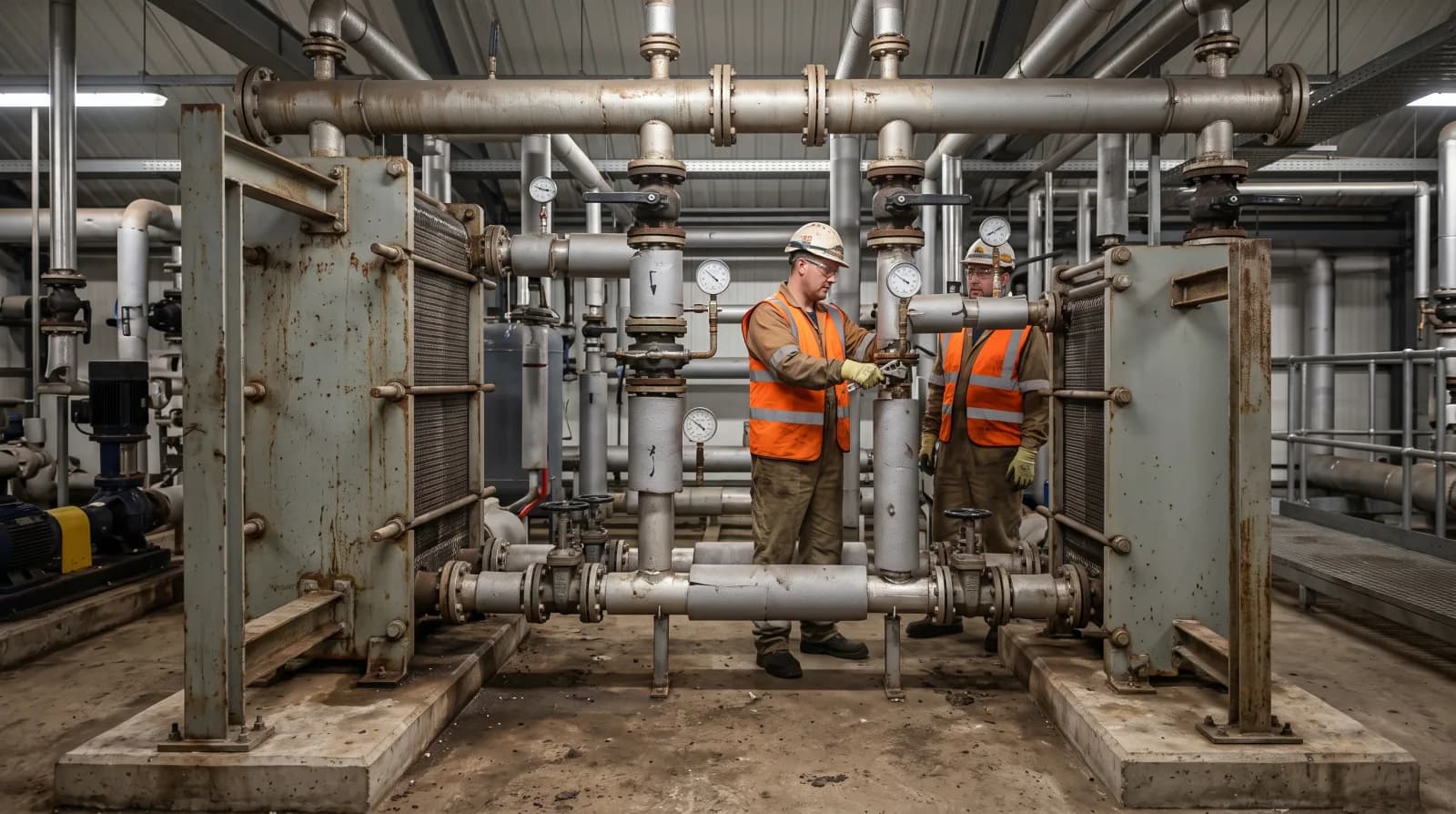
Heat exchanger breakdown: what to do before the engineer arrives
Heat exchanger breakdown stops production, and the first half hour decides how fast it restarts. This guide sets out what the decision rests on and what to gather before you make it.
Tell us about your repair or service
Five answers, all from memory. The detail comes next, and it is optional.
See the privacy notice for how these details are handled.
Common heat exchanger problems
It has failed or is leaking
Fluids mixing, a leak at the unit, or one that will not hold pressure.
Emergency repair →Losing dutyPerformance has dropped
Higher pressure drop, a wider approach temperature, or a duty it no longer reaches.
Cleaning options →PlannedA service or shutdown is coming
Planned maintenance, an outage window, or a spare that needs to be ready.
Servicing options →UnsureNot sure what is wrong
Send the nameplate and what you have noticed. That is enough to get an answer.
Send the details →The short answer
Isolate and make safe first. Do not tighten a leaking plate pack.
Record temperatures, pressures and where the leak shows, before the plant is drained.
Photograph the nameplate. It decides which parts and what test pressure.
Find the last service report and check whether any spares are held on site.
Ask whether the fastest fix is the one that stops you being back here in three months.
For whoever is standing in front of a failed exchanger deciding what to do next.
Make it safe first, and resist fixing it
Isolate, depressurise and drain in line with your own procedures. Pressure systems and hot fluids do not become less dangerous because there is production pressure to get going again, and a heat exchanger that has just failed is not in a state anyone can predict.
The specific temptation worth naming is tightening a leaking plate pack. It sometimes stops a weep, and every time it does it takes the pack closer to its minimum dimension. Below that figure the pack cannot seal at all and the plates begin to deform, which turns a gasket job into a plate replacement. Tightening a pack that is already leaking postpones a larger job rather than avoiding it.
Record what is happening while it is still happening
Most of this information disappears the moment the plant is shut down and drained, and it is the information that shortens the diagnosis.
- Temperatures and pressures, both sides
- Inlet and outlet on each side, and the pressure on each side. If it can still be read, read it before it is isolated.
- Where the leak appears
- Externally along the edge of a plate pack, or from a joint, or not externally at all, meaning it is passing between circuits.
- What changed, and when
- Whether it failed suddenly or has been drifting, and whether anything changed upstream: a chemical dose, a temperature setpoint, a new feed, a pump.
- Any evidence of cross contamination
- Conductivity, product appearance, water where it should not be. On a condenser, condensate conductivity. On a charge air cooler, water in the air receiver.
Photographs, taken properly
Photographs get an engineer to site with the right parts far more reliably than a description does. The useful ones are the nameplate, the whole unit in its installed position showing the pipework and access, the leak itself if it is visible, and the frame or channel end where the connections are.
The nameplate matters more than anything else. It carries the model, the design pressure and temperature and the serial number, and those determine which gaskets, which plates and what test pressure. A missing or painted-over nameplate genuinely slows the job down, so it is worth finding it and cleaning it off rather than assuming somebody has it on file.
Find the paperwork now, not later
Drawings, the original datasheet, the last inspection or service report and the written scheme of examination all shape what can be done. The service history matters especially: a unit rebuilt recently that has failed again is a different problem from one that has not been opened in a decade, and the difference changes where you look first.
For plate units, whether a spare set of gaskets or plates exists on site is the single question most likely to change the timescale.
Decide what you actually need
There is usually more than one route back to running, and they trade off differently.
Plugging failed tubes is the fastest way to get a shell and tube unit back on line, done through the open channel without withdrawing the bundle. It costs a little duty and it does not tell you anything about the rest of the bundle, but it is a real repair rather than a bodge.
Swapping in a spare unit or a spare plate pack turns the outage into a changeover, which is why holding one is worth costing properly for a critical duty.
A full repair takes longer and is the right answer when the failure is a symptom of general condition rather than an isolated event. The temptation in a breakdown is always the fastest option, and it is worth asking whether the fastest option is going to have you back here in three months.
What to have ready when you make the call
Type and size of unit, and the nameplate details. What has failed and how you know. The temperatures, pressures and flows at the time. What the duty is and what it serves, because that determines how urgent this actually is. Whether the unit can be isolated and removed, and what access is like. And whether any spares exist on site.
That list is short enough to gather in a few minutes and it is the difference between an engineer arriving to diagnose and an engineer arriving to repair.
Send an enquiry
Five answers to start, and the detail after. The enquiry is sent as soon as you have given the first five, so nothing is lost if you stop there.
What to copy off it
Make, model and serial number, design pressure and temperature, test pressure and year of manufacture. A photograph of the plate is quicker than typing it out.
Tell us about your repair or service
Five answers, all from memory. The detail comes next, and it is optional.
See the privacy notice for how these details are handled.