How a plate heat exchanger works, and what fails
How a plate heat exchanger works explains why the unit fails the way it does. This guide sets out what the decision rests on and what to gather before you make it.
Tell us about your repair or service
Five answers, all from memory. The detail comes next, and it is optional.
See the privacy notice for how these details are handled.
Common heat exchanger problems
It has failed or is leaking
Fluids mixing, a leak at the unit, or one that will not hold pressure.
Emergency repair →Losing dutyPerformance has dropped
Higher pressure drop, a wider approach temperature, or a duty it no longer reaches.
Cleaning options →PlannedA service or shutdown is coming
Planned maintenance, an outage window, or a spare that needs to be ready.
Servicing options →UnsureNot sure what is wrong
Send the nameplate and what you have noticed. That is enough to get an answer.
Send the details →The short answer
Corrugated plates in a compressed frame, sealed by gaskets, with the two fluids in alternate channels running counter to each other. That gives a close approach temperature and a high heat transfer coefficient in a small unit.
The same design decides the failures. Gaskets leak outward, cracked plates let the fluids mix, and narrow channels foul. Which one you have is usually clear from where the fluid is going and what the pressure drop is doing.
For anyone who has a plate heat exchanger to look after and wants to know why it is built the way it is, because that is what predicts what will go wrong with it.
What a plate heat exchanger is
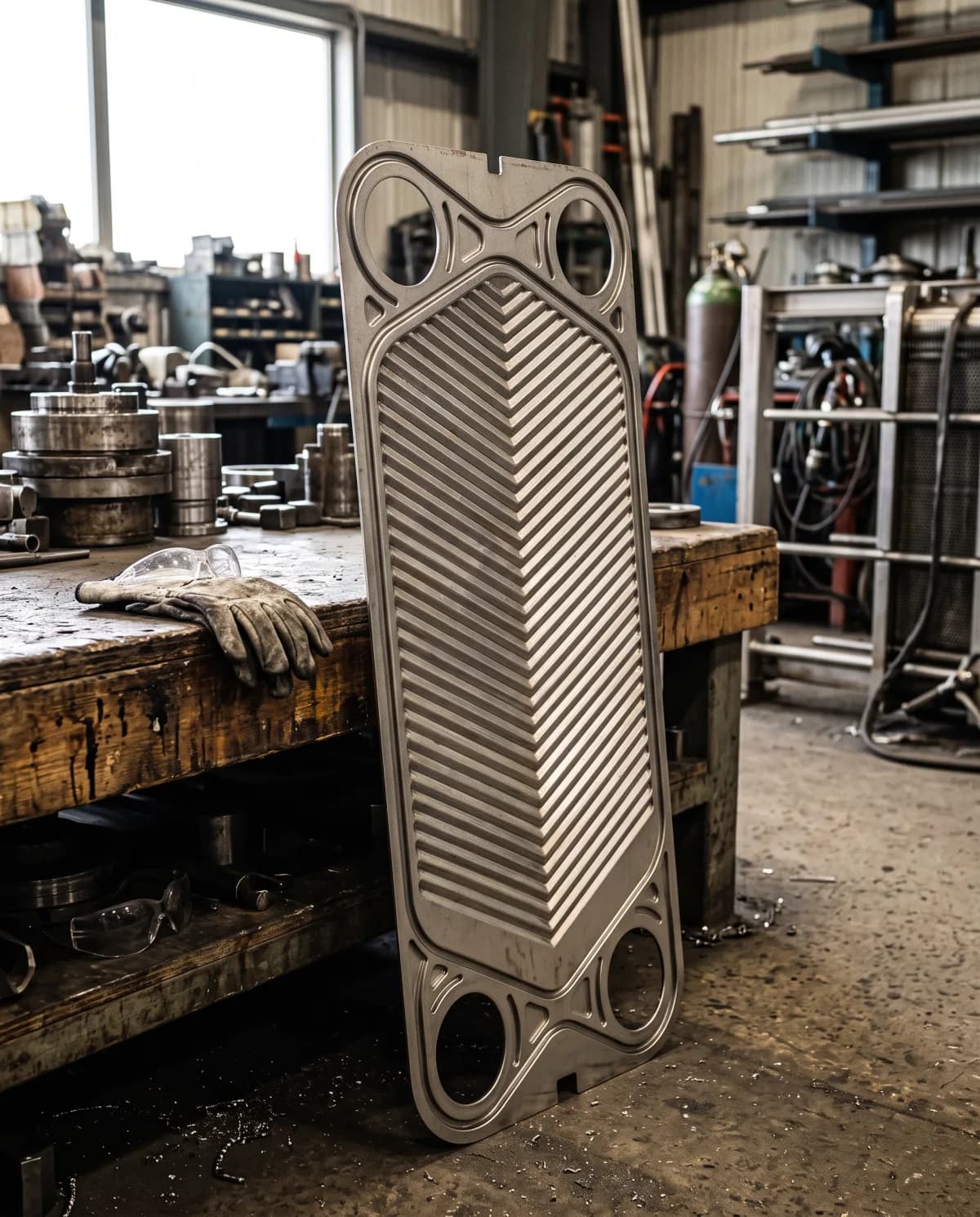
A plate heat exchanger transfers heat between two fluids through a stack of thin metal plates, without the fluids mixing. The plates are held in a frame between a fixed end plate and a movable follower plate, compressed together by tie bars. Richard Seligman produced the first commercially viable version in 1923, and the arrangement has not fundamentally changed since.
Each plate is pressed with a corrugated pattern, usually a chevron. The corrugations do two things at once. They hold the plates apart to form narrow channels, and they force the fluid into turbulent flow at low velocity, which is what makes the unit transfer heat efficiently in a small space.
Fluids enter through ports at the corners and flow through alternate channels, so every plate has hot fluid on one face and cold on the other. Gaskets around the edge of each plate seal the pack and direct each fluid into the right channels.
- Plates
- Usually stainless steel, sometimes titanium on seawater or aggressive duties. Thin, pressed, and the expensive part of the unit.
- Gaskets
- Elastomer seals around each plate. They set the pressure and temperature the unit can take, and they are the consumable part.
- Frame and tie bars
- Hold the pack compressed to a specified dimension. That dimension is what makes the gaskets seal.
- Ports
- The corner openings that carry each fluid in and out. Where cracks most often start.
Why it is efficient, in terms that matter for repair
Counter-flow arrangement, where the two fluids run in opposite directions, gives a plate heat exchanger a close approach temperature. It can work to a smaller difference between the two streams than a comparable shell and tube unit, which is why it is chosen where heat recovery matters.
The corrugations also produce a high overall heat transfer coefficient, so the same duty needs less surface area. That is the advantage. The cost is narrow channels, which foul more readily and block more completely than a tube does, and a pressure drop that climbs quickly as they do.
This is the whole reason approach temperature and pressure drop are the two numbers worth trending. They are not abstract measures, they are the direct readout of how open the channels still are.
What the design means when it fails
Three failures account for most plate heat exchanger work, and each one follows from the construction rather than being bad luck.
Gaskets harden, take a compression set and leak outward, because they are elastomers held under compression at temperature. That is a regasket. Plates crack or perforate, usually at the ports or where the corrugations touch, and then the two fluids mix rather than leaking out. That is a plate replacement, and no amount of tightening addresses it. Channels foul and the duty falls away, which is a clean rather than a repair.
The useful diagnostic follows directly. A leak to the outside is normally a gasket. Fluid appearing on the wrong side is normally a plate. Falling duty with rising pressure drop is normally fouling.
What can be opened and what cannot
A gasketed plate heat exchanger is designed to come apart, which is why it can be cleaned, inspected plate by plate, regasketed and rebuilt, and why capacity can sometimes be changed by adding plates.
A brazed plate unit has no gaskets. The plates are brazed into a sealed block, so it cannot be opened, cannot be regasketed and cannot be inspected internally. A fouled one can often be chemically cleaned; a failed one is replaced.
A welded or semi-welded pack sits between the two. Semi-welded units have welded plate pairs with gaskets between them, so one side opens and the other does not. Establishing which of the three you have is the first question on any enquiry, because it decides what is possible before anything else is discussed.
Send an enquiry
Five answers to start, and the detail after. The enquiry is sent as soon as you have given the first five, so nothing is lost if you stop there.
What to copy off it
Make, model and serial number, design pressure and temperature, test pressure and year of manufacture. A photograph of the plate is quicker than typing it out.
Tell us about your repair or service
Five answers, all from memory. The detail comes next, and it is optional.
See the privacy notice for how these details are handled.