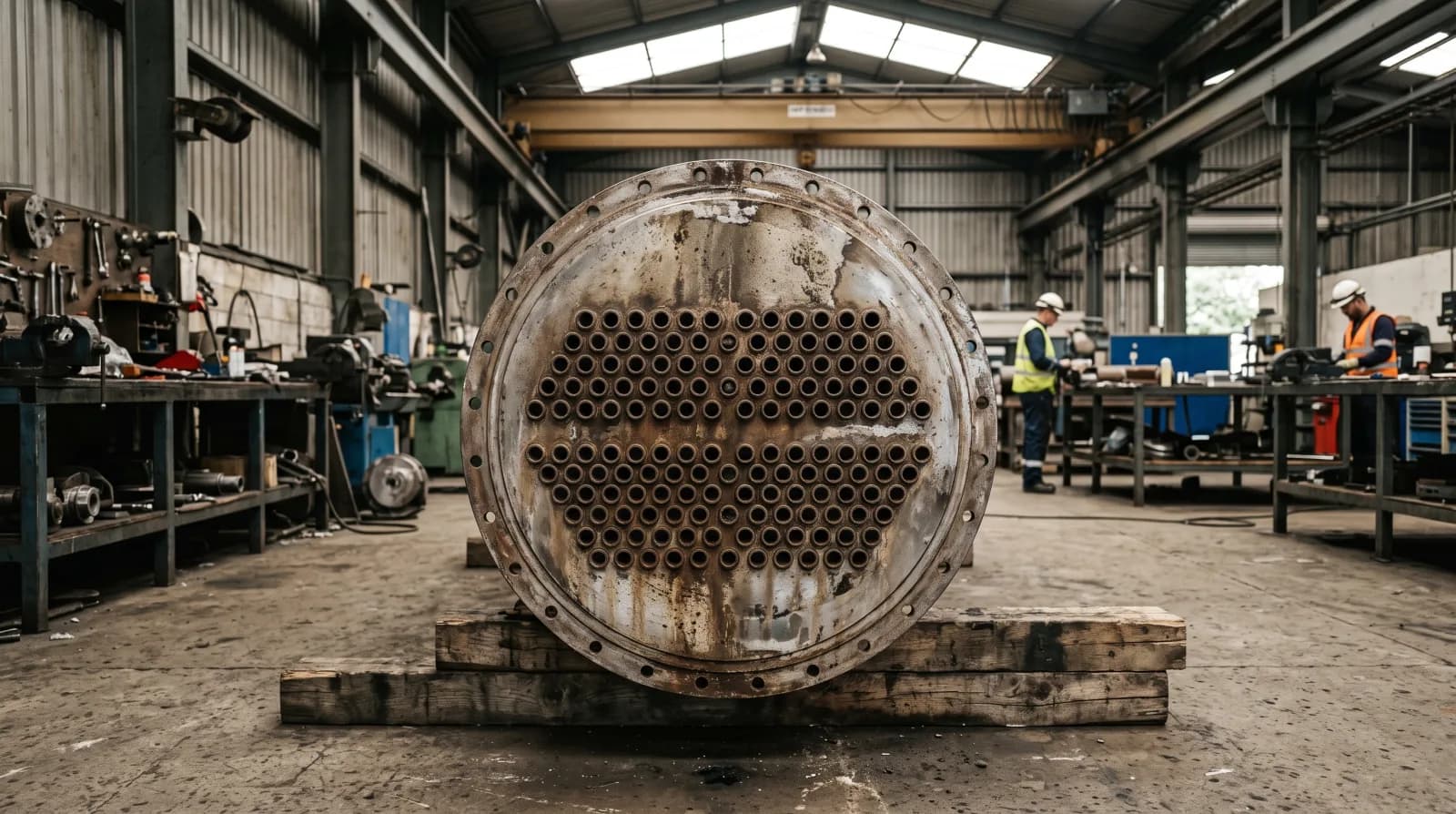
Plate or shell and tube heat exchanger repairs
Plate or shell and tube heat exchanger repairs come down to which part of the unit is still sound. This guide sets out what the decision rests on and what to gather before you make it.
Tell us about your repair or service
Five answers, all from memory. The detail comes next, and it is optional.
See the privacy notice for how these details are handled.
Common heat exchanger problems
It has failed or is leaking
Fluids mixing, a leak at the unit, or one that will not hold pressure.
Emergency repair →Losing dutyPerformance has dropped
Higher pressure drop, a wider approach temperature, or a duty it no longer reaches.
Cleaning options →PlannedA service or shutdown is coming
Planned maintenance, an outage window, or a spare that needs to be ready.
Servicing options →UnsureNot sure what is wrong
Send the nameplate and what you have noticed. That is enough to get an answer.
Send the details →The short answer
Repair the one whose expensive part is still sound. On a plate unit that is the frame and it usually is; on a shell and tube unit it is the shell, and a sound shell makes retubing economic.
Replace when the plates mostly fail inspection, when the shell is corroding, or when the parts are no longer obtainable. An inspection settles all three, and it costs a fraction of getting the decision wrong.
For anyone holding both types on a site and deciding where the maintenance budget goes, or facing a repair against replacement decision on one of them.
How the two types differ
A plate heat exchanger transfers heat through corrugated plates in a compressed frame. A shell and tube heat exchanger carries one fluid through a bundle of tubes and the other around them inside a shell, with baffles directing the shell side flow across the bundle.
The plate unit is compact and reaches a close approach temperature, so it does more with less surface area. The shell and tube unit handles higher pressures and temperatures, tolerates dirty and fibrous fluids that would block a plate channel, and has no gaskets between the two fluids to age.
How each one fails
Plate units fail at the gaskets, at the plates and through fouling of the narrow channels. Gasket failure leaks outward and is the most common. A cracked plate mixes the two fluids and is the failure that matters on a product duty.
Shell and tube units fail through tube wall thinning, tube to tubesheet joint leaks, baffle wear that frets the tubes, and corrosion of the shell or channels. Tube failures let the two circuits communicate; shell corrosion is the more serious finding because it is the pressure envelope.
- Plate, most common repair
- Regasketing, plate replacement and strip cleaning. The pack is designed to be opened, so the work is routine.
- Shell and tube, most common repair
- Tube plugging first, then retubing once failures spread across the bundle rather than sitting in one area.
- Plate, what ends its life
- Enough plates failing inspection that replacing them approaches the cost of a unit, or a model whose plates are no longer obtainable.
- Shell and tube, what ends its life
- Corrosion of the shell, channels or nozzles. The bundle can be renewed; the pressure envelope generally cannot.
Which is more likely to be worth repairing
Both usually are, and for the same reason: the expensive fabricated part is the one being kept. On a plate unit that is the frame; on a shell and tube unit it is the shell and channels. Repair economics turn on whether that part is sound, not on the age of the equipment.
The difference is what the inspection is looking for. On a plate unit the question is how many plates fail dye penetrant testing, because plates are the costly component. On a shell and tube unit the question is tube wall condition across the bundle, measured by eddy current or an ultrasonic method depending on the tube material, and whether the shell is corroding.
A plate unit whose plates mostly pass is nearly always worth rebuilding. A shell and tube unit with a sound shell is nearly always worth retubing. Reverse either of those findings and replacement starts to win.
When each type is the wrong choice for the duty
Repeated failures sometimes mean the wrong type is installed rather than a unit that needs repairing again. A plate unit on a fibrous or dirty fluid will block repeatedly whatever is done to it. A plate unit run beyond its gasket temperature will fail gaskets on a short cycle.
Equally, a shell and tube unit asked for a close approach temperature will never reach it, because the geometry does not allow it, and no repair changes that. Where a unit fails on the same schedule after each repair, the duty is worth checking before the next one is quoted.
Send an enquiry
Five answers to start, and the detail after. The enquiry is sent as soon as you have given the first five, so nothing is lost if you stop there.
What to copy off it
Make, model and serial number, design pressure and temperature, test pressure and year of manufacture. A photograph of the plate is quicker than typing it out.
Tell us about your repair or service
Five answers, all from memory. The detail comes next, and it is optional.
See the privacy notice for how these details are handled.