Retube or replace a heat exchanger: how to decide
Retube or replace a heat exchanger turns on the condition of the shell. This guide sets out what the decision rests on and what to gather before you make it.
Tell us about your repair or service
Five answers, all from memory. The detail comes next, and it is optional.
See the privacy notice for how these details are handled.
Common heat exchanger problems
It has failed or is leaking
Fluids mixing, a leak at the unit, or one that will not hold pressure.
Emergency repair →Losing dutyPerformance has dropped
Higher pressure drop, a wider approach temperature, or a duty it no longer reaches.
Cleaning options →PlannedA service or shutdown is coming
Planned maintenance, an outage window, or a spare that needs to be ready.
Servicing options →UnsureNot sure what is wrong
Send the nameplate and what you have noticed. That is enough to get an answer.
Send the details →The short answer
Sound shell with worn tubes is a retube. Corroded shell is usually a replacement.
Inspect before deciding. Age and plugged tube count are the wrong basis.
Plugging and sleeving are legitimate answers, not compromises, where the failures are few or local.
Lead times and access decide more of these than engineering does, so establish both early.
For anyone holding an inspection report on an ageing shell and tube unit and deciding what to do with it.
The question is about the shell, not the tubes
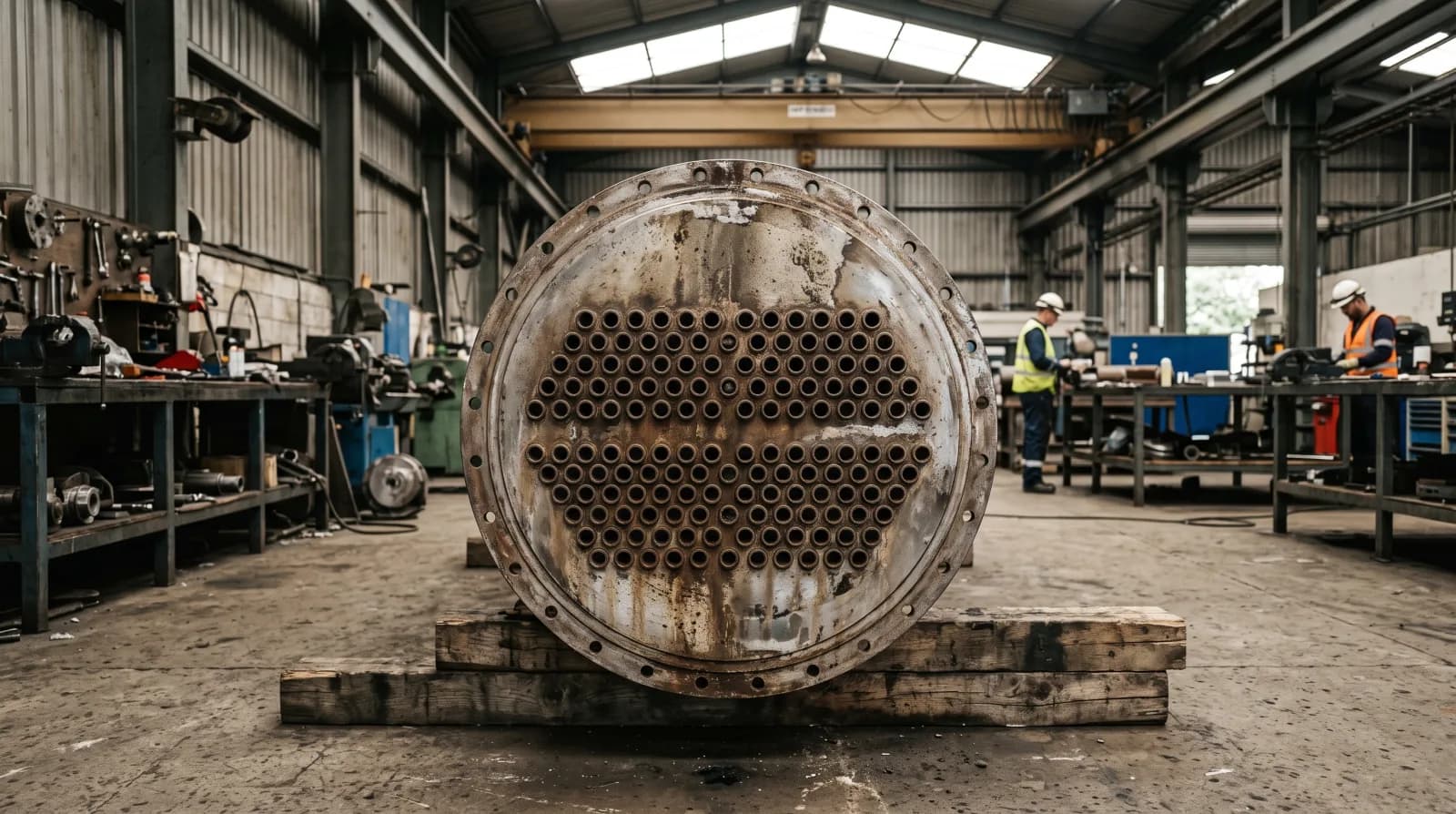
Retubing keeps the shell, the channels, the nozzles, the covers and the supports. Those are the expensive fabrication, and on most units they outlive several sets of tubes. That is the whole economic case for retubing, and it holds for as long as the shell is sound.
So the first question is not how bad the tubes are. It is what condition the pressure envelope is in. A unit with badly corroded tubes and a sound shell is usually a straightforward retube. A unit with a corroded shell is usually a replacement, however good a retube would look on paper, because you would be spending the cost of new tubes on equipment that fails somewhere else shortly afterwards.
This is why an inspection before the decision pays for the cost of the decision being wrong. Deciding from the age of the unit, or from the number of tubes plugged, uses the wrong information.
What pushes toward retubing
- The shell and channels are in good condition
- The single strongest argument. You are keeping the majority of the value of the unit.
- The design still suits the duty
- If the exchanger did its job when it was new and the process has not changed, replacing it buys you the same performance at a higher price.
- The unit is awkward to replace
- Plant is often built around large exchangers. Where removal means dismantling structure or breaking into pipework runs, retubing avoids a disproportionate amount of work.
- You want to change tube material
- A retube is the natural moment to correct metallurgy that never suited the water chemistry or process fluid. Doing it now is far cheaper than doing it twice.
What pushes toward replacement
- Shell side corrosion
- Once the pressure envelope needs significant weld repair, the sums change quickly and the risk of finding more once work starts is real.
- The duty has outgrown the unit
- If the process has grown and the exchanger has been struggling for years, retubing restores it to a performance that was already inadequate.
- Lead time on tube material
- Exotic materials can carry long lead times, and a shutdown window will not wait. Sometimes a replacement unit is available sooner than the tubes to repair the old one.
- Access and handling
- If the bundle cannot be withdrawn, or there is nowhere to put it, the practical difficulty can outweigh the theoretical saving.
- The written scheme is becoming difficult to satisfy
- Where a competent person is increasingly reluctant to certify the unit, that is a signal worth taking at face value.
The middle options people forget
It is not a binary choice. Plugging failed tubes buys time and costs very little, and on a bundle with a handful of failures it is the right answer rather than a compromise. Sleeving addresses inlet end erosion specifically, which is a common failure pattern and does not justify a full retube on its own.
A replacement bundle is worth asking about too. On some designs the bundle can be bought or made as a unit and swapped, which reduces the outage considerably compared with retubing in place, and keeps the shell.
And there is the spare unit question. Where a duty is critical, holding a refurbished spare turns a failure into a swap and a short changeover. That is worth costing against the price of the outage you would otherwise take, and the comparison often surprises people.
Getting a decision you can defend
A firm retube price given before the unit has been opened is an estimate. The realistic sequence is inspection, then scope, then price, and the inspection costs little against the decision it informs.
Two inspections are worth more than one. A single set of results gives you the condition; two give you the rate of loss, and the rate is what lets you plan the next shutdown rather than react to the next failure.
Whatever is decided, record why. The next person facing this decision on the same unit, probably in several years, will otherwise start from nothing, and the reasoning is usually more valuable than the numbers.
Send an enquiry
Five answers to start, and the detail after. The enquiry is sent as soon as you have given the first five, so nothing is lost if you stop there.
What to copy off it
Make, model and serial number, design pressure and temperature, test pressure and year of manufacture. A photograph of the plate is quicker than typing it out.
Tell us about your repair or service
Five answers, all from memory. The detail comes next, and it is optional.
See the privacy notice for how these details are handled.