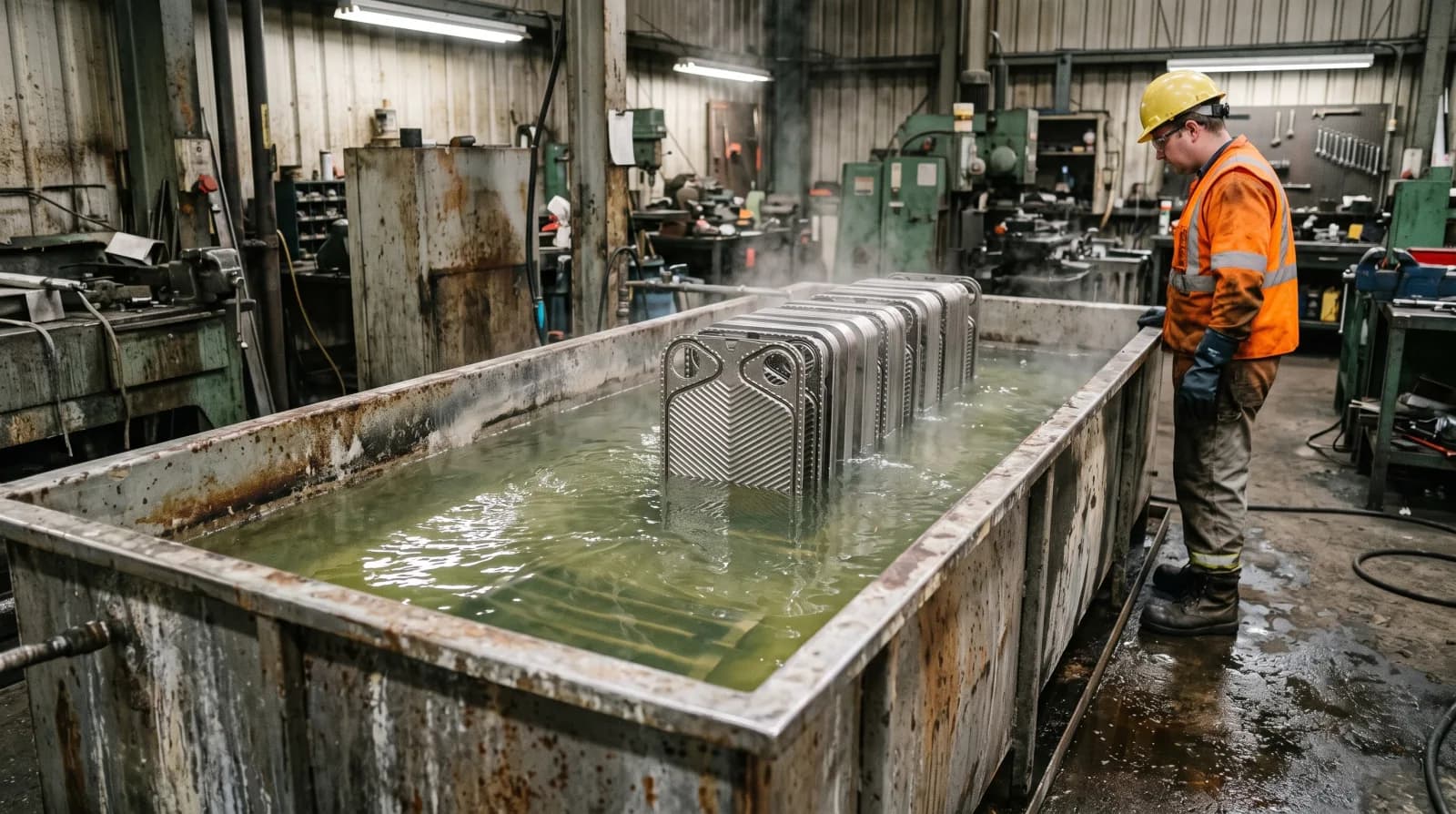
Heat exchanger fouling: what it costs and when to act
Heat exchanger fouling costs you duty, pressure drop and fuel every day it is left. This guide sets out what the decision rests on and what to gather before you make it.
Tell us about your repair or service
Five answers, all from memory. The detail comes next, and it is optional.
See the privacy notice for how these details are handled.
Common heat exchanger problems
It has failed or is leaking
Fluids mixing, a leak at the unit, or one that will not hold pressure.
Emergency repair →Losing dutyPerformance has dropped
Higher pressure drop, a wider approach temperature, or a duty it no longer reaches.
Cleaning options →PlannedA service or shutdown is coming
Planned maintenance, an outage window, or a spare that needs to be ready.
Servicing options →UnsureNot sure what is wrong
Send the nameplate and what you have noticed. That is enough to get an answer.
Send the details →The short answer
Trend approach temperature and pressure drop, taken consistently. Both are usually already logged.
Widening approach plus rising pressure drop is fouling. Sharp pressure drop rise alone is more likely a blockage.
Work the cost out from your own energy or production figures rather than from a rule of thumb, then set it against the cost of the clean and the downtime.
A cleaning interval that keeps shortening is a signal about something upstream, not a reason to clean more often.
For anyone deciding whether an exchanger is due a clean, or arguing for the budget to do it.
Fouling is a cost before it is a fault
Fouling develops gradually. The unit carries on working, and performance falls away slowly enough that the change is easy to miss until something downstream cannot keep up.
That is why fouling is usually discovered by accident, and why cleaning intervals get set by habit rather than by evidence. A unit gets cleaned every twelve months because it always has been, which means it is either being cleaned when it did not need it or long after it should have been. Both are expensive, and the second one is expensive in a way that does not appear on any maintenance line.
The two numbers you probably already have
You do not need a thermal model to know whether an exchanger is fouling. Two measurements, taken consistently, will tell you almost everything, and most plants are already logging both without looking at them.
- Approach temperature
- The gap between the outlet of one stream and the inlet of the other. As a surface fouls, that gap widens, because the exchanger can no longer pull the temperatures as close together. Watch the trend rather than the value: what matters is that it is wider than it was, on comparable flows and inlet temperatures.
- Pressure drop
- How much pressure the fluid loses passing through. As deposit narrows the flow path, it rises. A rising pressure drop alongside a widening approach temperature is fouling, and it is close to conclusive.
Reading the two together
The combination tells you more than either alone. Approach temperature widening while pressure drop stays flat suggests an insulating layer on the surface without much narrowing of the channel, which is what scale and biofilm often look like early on. Both rising together suggests deposit building up enough to restrict flow as well, and that is a unit heading toward a blockage rather than simply running dirty.
Pressure drop rising sharply with little change in approach temperature usually means something has partly blocked rather than fouled: debris, a piece of gasket, product solids in a channel. That is a different problem and often a faster one to fix.
Comparing like with like is what makes any of this work. Flows, inlet temperatures and ambient conditions all move the numbers, so a reading taken on a hot afternoon at reduced throughput is not comparable with one from a cold morning at full rate. Consistency in when and how you take the reading matters more than precision in taking it.
Turning it into money
The cost of fouling is specific to your plant, which is why a general percentage figure means very little. What you can do is work it out from figures you already hold.
Where the exchanger serves a utility, the cost usually shows up as energy: a chiller or boiler running longer to make up the shortfall. You can approximate it from the extra running time and your energy tariff, and that number is usually enough to settle the argument on its own.
Where the exchanger is on a process duty, the cost may be production rather than energy: a slower cycle, a lower rate, or product held back because a cooling step is not keeping up. That number is normally much larger than the energy one, and it is the one worth finding if it applies.
Set either against what the clean would cost, including the downtime it needs, and the decision usually makes itself. If it does not, the honest conclusion is that the unit is not fouled enough to be worth cleaning yet, which is a perfectly good answer and worth having in writing.
When cleaning is the wrong answer
If the cleaning interval keeps getting shorter, the problem is not the exchanger. Something upstream has changed: water treatment, velocity, a temperature profile, a feed. Cleaning more often treats the symptom and hides the cause, and the interval will keep shrinking until something else forces the issue.
If performance does not recover after a clean, the deposit was not what limited it. That points at a mechanical problem, at plugged tubes reducing surface area, or at the exchanger being genuinely undersized for a duty that has grown since it was specified.
And fouling is not only a thermal problem. Deposits shield the metal underneath from corrosion inhibitor and hold water and contaminants against the surface, so a unit left dirty is degrading as well as underperforming. On process plant that makes cleaning a reliability decision rather than an efficiency one.
Send an enquiry
Five answers to start, and the detail after. The enquiry is sent as soon as you have given the first five, so nothing is lost if you stop there.
What to copy off it
Make, model and serial number, design pressure and temperature, test pressure and year of manufacture. A photograph of the plate is quicker than typing it out.
Tell us about your repair or service
Five answers, all from memory. The detail comes next, and it is optional.
See the privacy notice for how these details are handled.