Heat exchanger fault diagnosis
Heat exchanger fault diagnosis identifies the fault behind the symptom. Send the nameplate and what has happened, and a specialist who works on that type will come back to you. Coverage is UK wide.
Tell us about your heat exchanger fault diagnosis
Five answers, all from memory. The detail comes next, and it is optional.
See the privacy notice for how these details are handled.
Common problems that need heat exchanger fault diagnosis
It has failed or is leaking
Fluids mixing, a leak at the unit, or one that will not hold pressure.
Emergency repair →Losing dutyPerformance has dropped
Higher pressure drop, a wider approach temperature, or a duty it no longer reaches.
Cleaning options →PlannedA service or shutdown is coming
Planned maintenance, an outage window, or a spare that needs to be ready.
Servicing options →UnsureNot sure what is wrong
Send the nameplate and what you have noticed. That is enough to get an answer.
Send the details →When a diagnosis is the right first step
Heat exchanger fault diagnosis establishes what has failed before any work is quoted, because the same symptom can come from three different faults with three different repairs. Diagnosis is the right first step in these situations.
- Something is wrong and it is not clear whether it is the exchanger or the system around it
- A leak with no obvious source
- Performance that has fallen away with no change to the process
- A unit that has been repaired before and has failed again
- Equipment inherited with no history and no recent inspection record
How a fault is diagnosed
Start with the numbers
Inlet and outlet temperatures both sides, pressure drop, and flow if it is measured. Those four readings separate a fouling problem from a leak and from a system problem, before anyone touches the unit.
Establish where the fluid is going
Losing fluid to the outside and passing it between circuits are different faults. Pressure testing each side separately is what tells them apart.
Open and inspect
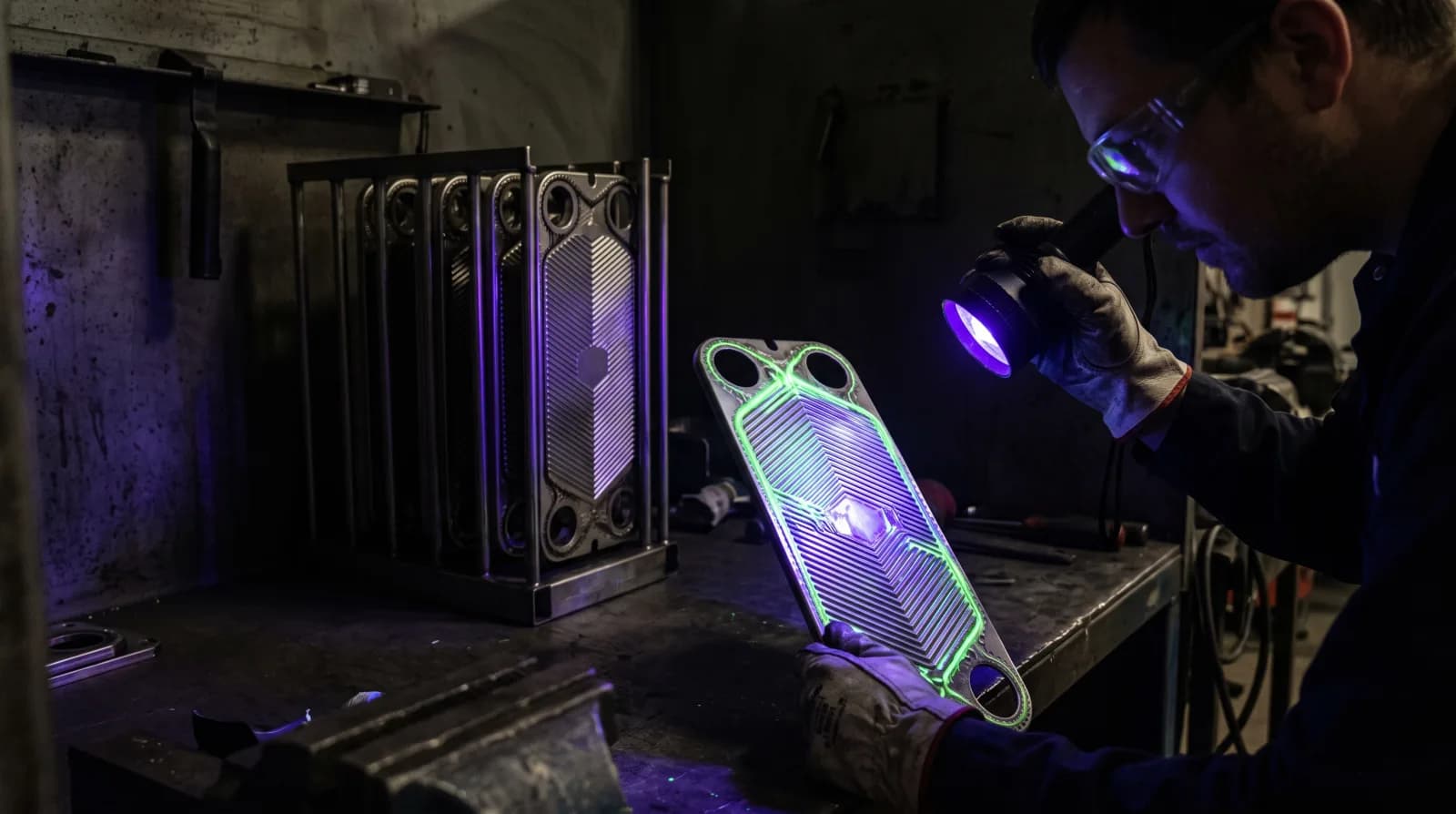
Once the unit is open and clean, the surfaces can be examined properly. On plate units that means checking plates for cracks and pinholes; on tubular units it means testing tube wall condition.
Report and options
The output is what has failed, what condition the rest of the unit is in, and the realistic options with what each one does and does not solve.
What makes a diagnosis useful
Evidence gathered before the plant is drained
Temperatures, pressures and where the leak showed all disappear the moment the system is shut down and emptied. Recording them first shortens everything that follows.
The nameplate and any drawings
The nameplate and drawings set the design conditions, the materials and the test pressure. Without them, more has to be established the slow way.
The history
What was done last time, and when, often points straight at the cause. A unit failing the same way repeatedly has a problem upstream of the exchanger.
Cleaning before assessment
Nothing can be inspected through a layer of deposit, which is why cleaning comes before condition is judged rather than after.
Heat exchanger fault diagnosis questions
Can a fault be diagnosed without opening the unit?
Partly. The numbers and a pressure test narrow it down a long way and will often identify the type of fault. Readings and a pressure test cannot establish the condition of surfaces nobody has looked at.
My unit was repaired recently and has failed again. Why?
Usually because the repair addressed the failure and not the cause. If water treatment, flow velocity or a temperature profile drove the failure, the same failure returns on the same schedule.
What does a diagnosis cost?
It depends on the unit and where it is, but unlike the repair it can usually be established up front, which is why an assessment is quoted before the work rather than alongside it.