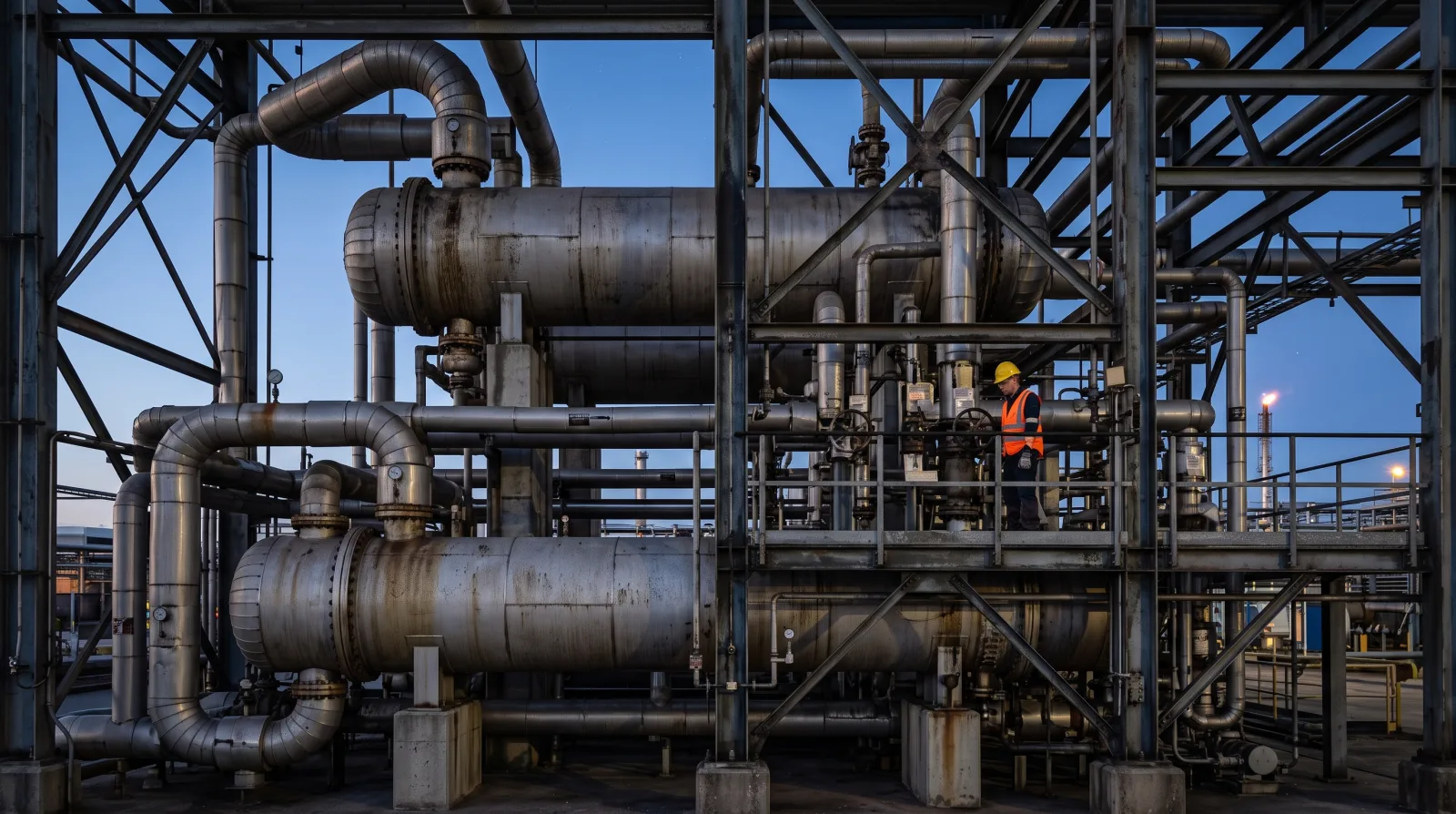
Heat exchanger repairs for oil, gas and refining
Heat exchanger repairs for oil, gas and refining cover process units, turnarounds and shutdown work. Send the nameplate and what has happened, and a specialist who works on that type will come back to you. Coverage is UK wide.
Tell us about your oil, gas and refining
Five answers, all from memory. The detail comes next, and it is optional.
See the privacy notice for how these details are handled.
Common heat exchanger problems for oil, gas and refining
It has failed or is leaking
Fluids mixing, a leak at the unit, or one that will not hold pressure.
Emergency repair →Losing dutyPerformance has dropped
Higher pressure drop, a wider approach temperature, or a duty it no longer reaches.
Cleaning options →PlannedA service or shutdown is coming
Planned maintenance, an outage window, or a spare that needs to be ready.
Servicing options →UnsureNot sure what is wrong
Send the nameplate and what you have noticed. That is enough to get an answer.
Send the details →Heat exchangers used in oil, gas and refining
Heat exchanger repairs for oil, gas and refining are governed by the turnaround, which is scoped and resourced years ahead. A fixed turnaround date makes condition monitoring between outages worth more here than almost anywhere else.
- Shell and tube exchangers in large numbers, often in trains
- Air-cooled fin fan units where cooling water is limited
- Condensers and reboilers on distillation columns
- Feed and effluent exchangers recovering heat across a process
- Materials well beyond carbon steel: duplex, titanium, and clad or lined equipment
How fouling affects refinery heat exchangers
- Coking
- At high enough temperatures hydrocarbon deposits carbonise onto the tube surface. Hard, tenacious, and generally beyond chemical cleaning, which is why mechanical methods dominate here.
- Asphaltene and polymer deposits
- Heavy fractions dropping out onto surfaces, with the deposit changing character depending on the feed. A change in crude slate can change the fouling behaviour of exchangers that were stable for years.
- Corrosion under deposit
- The deposit shields the metal from inhibitor and holds water and contaminants against it. That is why fouling here is a corrosion problem as well as a thermal one, and why cleaning intervals are a reliability question.
- Sour service
- Where hydrogen sulphide is present, material selection and any weld repair have to account for it. Sour service constrains repair methods, not only the original design.
What affects heat exchanger repairs on a refinery
The turnaround is the whole programme
Work is planned around a shutdown scoped and resourced long in advance. Inspection between turnarounds therefore earns its cost several times over, because a bundle assessed in advance enters the outage plan with a scope already attached.
Written schemes and certification
Pressure systems sit under PSSR 2000 with a written scheme of examination, and repair methods have to leave equipment certifiable against it. ASME PCC-2 is the usual reference for exchanger tube repair.
Permits, isolation and hot work
Access is governed by permit and by isolation, and hot work brings its own controls. It is one reason mechanical tube plugs, which avoid welding, have displaced welded tapered plugs in a lot of plants.
Materials and lead times
Duplex, titanium and clad components carry lead times that decide whether a retube is possible in a given window. Metallurgy is settled early or it settles the programme for you.
Bundles are heavy and access is tight
Withdrawing a bundle needs an extractor and space to put it, and both are frequently the practical limit rather than the repair itself.
Oil, gas and refining questions
When should exchangers be inspected if the turnaround is years away?
Between turnarounds, precisely because the turnaround is years away. An inspection is what turns a guess into a scope with the right materials ordered, and finding the problem during the shutdown is the expensive way to discover it.
Why does cleaning matter for reliability rather than just efficiency?
Because deposits shield the metal underneath from corrosion inhibitor and hold water and contaminants against the surface. Corrosion under deposit is a common failure mechanism, so a fouled exchanger is degrading as well as underperforming.
Is retubing realistic within a shutdown window?
Tube material lead time, the number of units and whether the bundle can be withdrawn off the critical path all decide it. It is a planning question more than a technical one, which is why the inspection that sets the scope matters so much.