Heat exchanger repairs for power generation
Heat exchanger repairs for power generation cover condensers, oil coolers and auxiliary plant. Send the nameplate and what has happened, and a specialist who works on that type will come back to you. Coverage is UK wide.
Tell us about your power generation
Five answers, all from memory. The detail comes next, and it is optional.
See the privacy notice for how these details are handled.
Common heat exchanger problems for power generation
It has failed or is leaking
Fluids mixing, a leak at the unit, or one that will not hold pressure.
Emergency repair →Losing dutyPerformance has dropped
Higher pressure drop, a wider approach temperature, or a duty it no longer reaches.
Cleaning options →PlannedA service or shutdown is coming
Planned maintenance, an outage window, or a spare that needs to be ready.
Servicing options →UnsureNot sure what is wrong
Send the nameplate and what you have noticed. That is enough to get an answer.
Send the details →Heat exchangers used in power generation
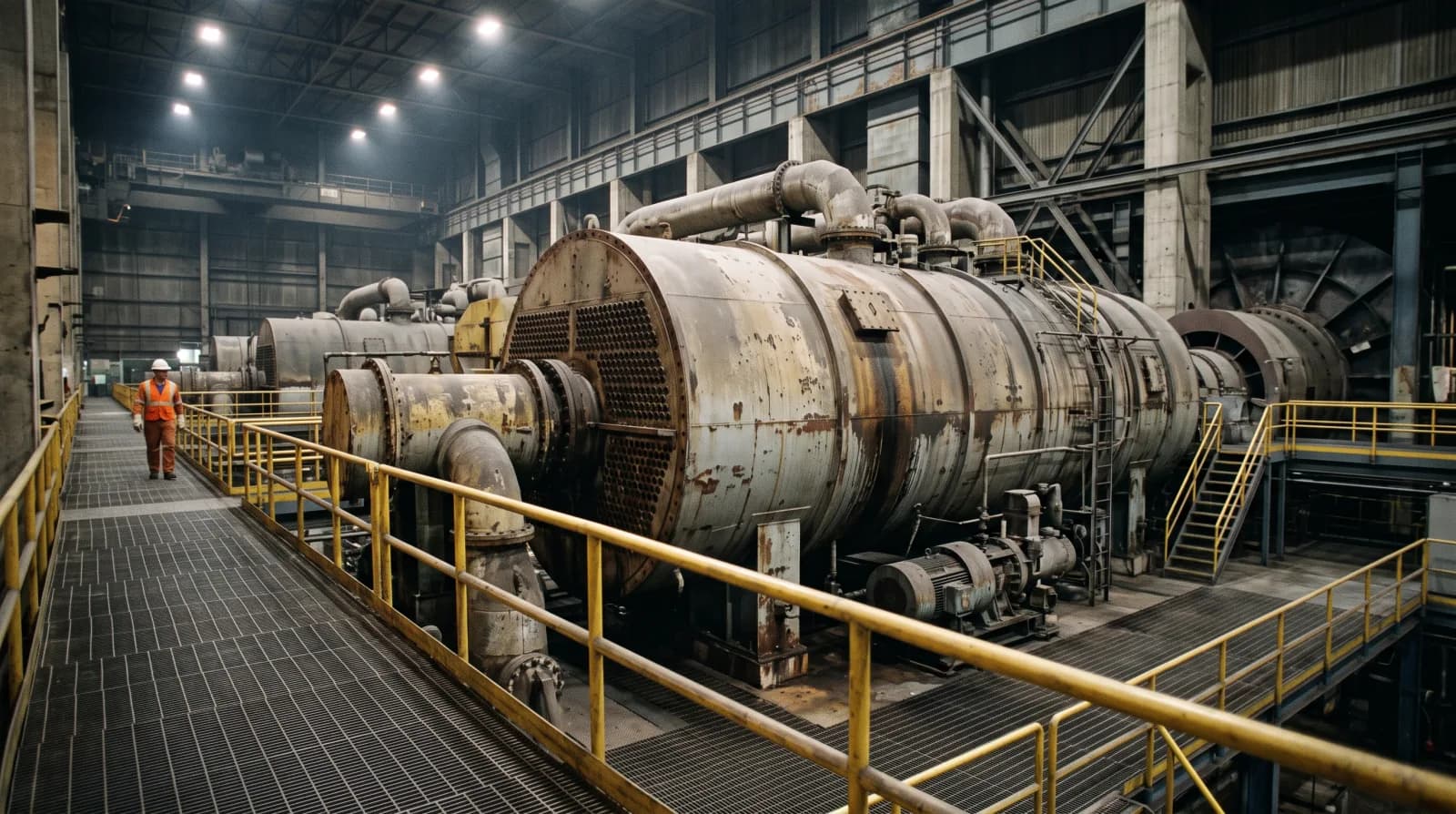
Heat exchanger repairs for power generation turn on outages and on vacuum. One leaking condenser tube contaminates the water and steam circuit, and lost vacuum costs output long before anything fails outright.
- Surface condensers with tube counts in the thousands
- Feedwater heaters and auxiliary coolers
- Generator and transformer cooling, including hydrogen coolers on larger machines
- Plate exchangers on closed cooling water circuits
- Air-cooled units where cooling water is restricted
How fouling affects power station heat exchangers
- Raw cooling water
- River, estuary and sea water bring silt, biological growth and debris continuously rather than occasionally. Tube side fouling is a running condition to be managed, not an event.
- Macrofouling
- Mussels, weed and larger debris blocking tubes and waterboxes outright. Screens and dosing keep it in check, and a lapse shows up as blocked tubes rather than as a gradual decline.
- Inlet end erosion
- Concentrated tube damage in the first part of the tube from turbulence and entrained material. Inlet end erosion is why protection and sleeving are so common on condensers.
- Vacuum is the measure
- Fouling shows as deteriorating vacuum, and worse vacuum is directly lost output. On a condenser the thermal penalty converts straight into money in a way it does not on most exchangers.
What affects heat exchanger repairs at a power station
Outages, and the space between them
Everything invasive happens in an outage, so what can be measured while running, like conductivity and vacuum, carries more weight than it does elsewhere. Trending between outages is what makes the scope right.
Leaks draw inward
Because the shell side is under vacuum, a tube leak pulls cooling water into the condensate rather than leaking outward. Conductivity detects it, and helium is what locates it, since a conventional pressure test does not reproduce the condition.
Scale changes the method
With thousands of tubes, finding the failure by elimination is not realistic. Eddy current for assessing the bundle and helium for locating a leak are the practical tools rather than the fancy ones.
Chemistry limits are strict
Water and steam circuit chemistry is tightly controlled, so even a small in-leak matters. The cost of contaminated condensate is what justifies acting on a conductivity trend early.
Waterbox condition and cathodic protection
Linings, tubesheet cladding and anodes are what stop the same corrosion returning after a tube repair, and they are the part of the scope most often left out.
Power generation questions
Condensate conductivity is rising. What now?
Treat it as a condenser tube leak and locate it. Because the shell side is under vacuum, cooling water is being drawn into the condensate, and the chemistry limits on the circuit mean even a small in-leak is worth stopping. Helium leak detection is the usual way to find which tube.
Vacuum has fallen but the condensate is clean. Why?
That pattern points at air ingress rather than a tube leak: air drawn in through joints, glands or the shell. Air ingress costs output in the same way as a tube leak and is found by a different search, so establishing which one you have comes before opening anything.
How many tubes can be plugged before it matters?
There is no useful percentage. Plugging reduces the surface available and therefore the vacuum you can hold, and it is the vacuum that determines lost output. The number to watch is the vacuum you are still achieving.