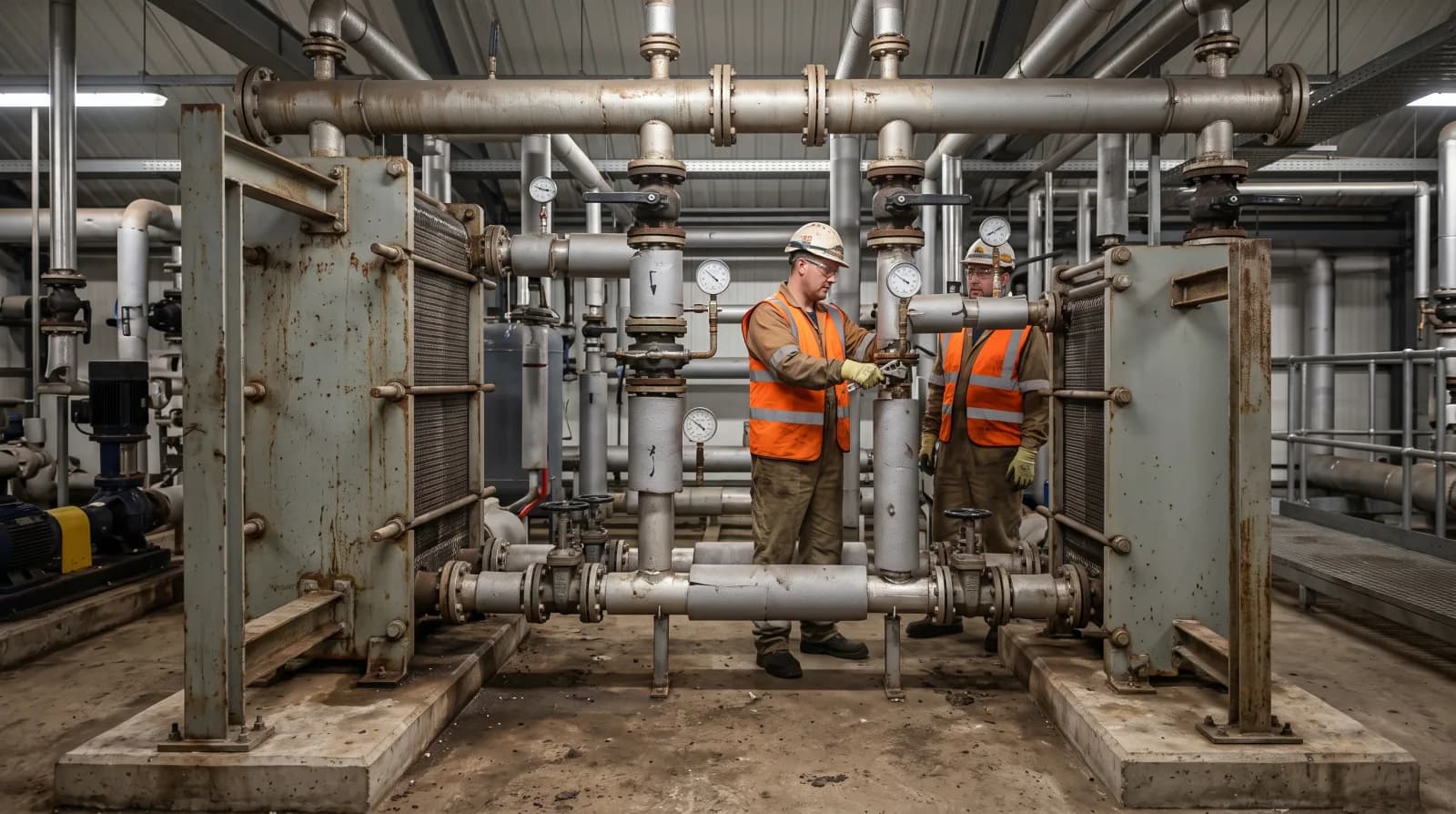
Plate heat exchanger servicing
Plate heat exchanger servicing keeps a working pack working through a planned strip and rebuild. Send the nameplate and what has happened, and a specialist who works on that type will come back to you. Coverage is UK wide.
Tell us about your plate heat exchanger servicing
Five answers, all from memory. The detail comes next, and it is optional.
See the privacy notice for how these details are handled.
Common plate heat exchanger problems
Weeping at the pack
A leak along the edge of the plate pack, usually the gaskets rather than the plates.
Regasketing →Cross contaminationThe two fluids are mixing
Product or utility appearing on the wrong side, which normally means a cracked plate.
Repair options →Losing dutyPressure drop up, duty down
Fouling between the plates, widening the approach temperature and restricting flow.
Cleaning options →UnsureNot sure what is wrong
Send the nameplate and what you have noticed. That is enough to get an answer.
Send the details →When to service a plate heat exchanger
Plate heat exchanger servicing is planned work on a pack that has not failed. Its main output is knowing the condition of every plate, which a clean on its own does not give you. These are the cases where it is worth scheduling.
- The unit is on a critical duty and there is no standby to swap in
- Performance has drifted gradually rather than failed suddenly
- Gaskets are approaching the end of their service life, which temperature and fluid drive more than age
- A planned shutdown is coming and the exchanger is the item nobody has looked inside
- The unit was bought second hand, or inherited, and has no service history at all
What plate heat exchanger servicing includes
Send the details
The nameplate, the duty, and when your window is. Servicing is planned work, so timing usually shapes the plan.
Strip, clean and inspect
Plates come out, are cleaned, and are checked for cracks and pinholes. Plate inspection is the point of a service. A clean alone does not establish plate condition.
Regasket and rebuild
Gaskets replaced as a set, plates replaced where they fail, and the pack rebuilt to dimension.
Report and interval
What was found, and whether the interval is right. Set against the last report, that is what turns servicing into a plan.
Planning a plate heat exchanger service
On site or in a workshop
On site avoids transport and suits a straightforward regasket. A workshop gets chemical tanks, proper inspection and oven cured gaskets, and it is the difference between a unit that is clean and a unit whose condition is known.
Whether a spare exists
A second unit or a spare plate pack turns a service into a swap and a short changeover. Without one, the service takes the duty offline for as long as the work lasts, and that usually decides the whole approach.
Setting the interval
There is no universal figure. A duty with clean water and modest temperatures goes years; a dairy or a heavily fouling process does not. Approach temperature and pressure drop are what should set it, not the calendar.
Plate and gasket availability
Both are model specific. For older or discontinued units, availability is the real constraint on turnaround. Checking it before the pack is opened stops a stripped unit waiting on a gasket set.
Plate heat exchanger servicing questions
How do you service a plate heat exchanger?
The pack is recorded and measured before anything is disturbed, then stripped, the plates cleaned and inspected, gaskets replaced as a set, and the pack rebuilt to its recorded dimension and pressure tested. The plate inspection is what separates a service from a clean.
What has to be done before a plate pack is disassembled?
The unit is isolated, drained and allowed to cool, and the tightened pack dimension and plate order are recorded. A pack reassembled in the wrong order does not work, and the sequence cannot be reconstructed afterwards.
Are plate heat exchangers easy to maintain?
Comparatively, yes, because the pack is built to be opened, the plates come out individually and capacity can be changed by adding or removing plates. What that ease depends on is a recorded plate order and gaskets that are still available for the model.
How often should a plate heat exchanger be serviced?
On condition rather than on a fixed interval. Monitor approach temperature and pressure drop: when performance has drifted enough to cost more than the service would, it is due. Duties that foul hard need it far more often than the same unit on clean water.
What is the difference between servicing and repairing?
A repair fixes something that has failed. A service is done before it fails, and its main output is knowing the condition of every plate. The two overlap when a service finds a cracked plate, which is common enough that it should not be a surprise.
Can a unit be serviced without taking it out of the plant?
The pack can be opened and regasketed in place where there is room to work. What cannot be done on site is proper tank cleaning and inspection under ultraviolet light, so an in situ service leaves the plate condition unproven.