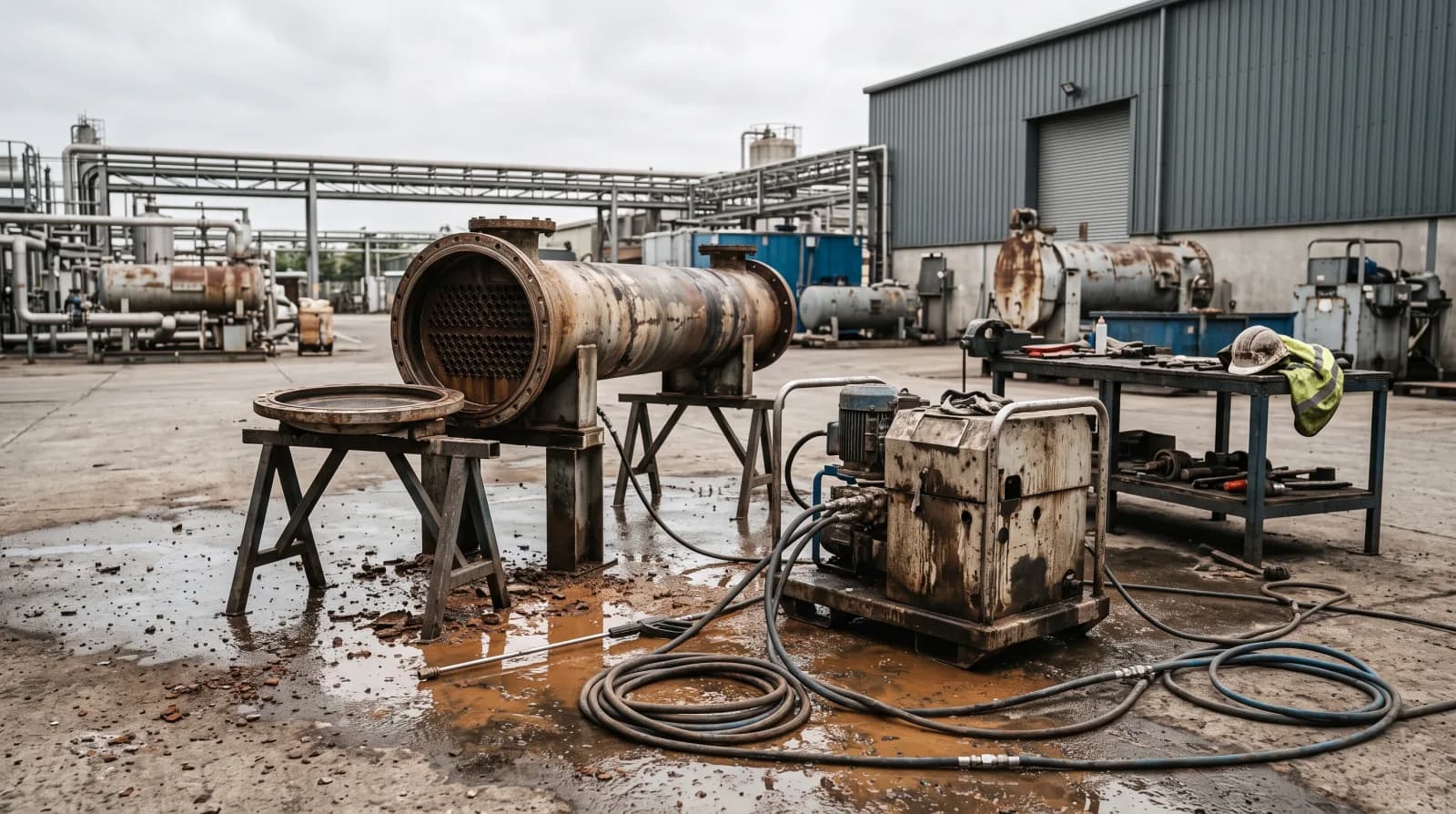
Shell and tube heat exchanger cleaning
Shell and tube heat exchanger cleaning clears deposit from inside the tubes and around the bundle. Send the nameplate and what has happened, and a specialist who works on that type will come back to you. Coverage is UK wide.
Tell us about your shell and tube heat exchanger cleaning
Five answers, all from memory. The detail comes next, and it is optional.
See the privacy notice for how these details are handled.
Common shell and tube problems
A tube is leaking
Fluid crossing between the shell and tube sides, from a tube or a tube to tubesheet joint.
Tube plugging →Bundle conditionWall loss across the bundle
Repeat failures in different tubes, or a plugged tube count that keeps rising.
Retubing →Plant downIt has failed or is leaking
Fluids mixing, a leak at the unit, or one that will not hold pressure.
Emergency repair →UnsureNot sure what is wrong
Send the nameplate and what you have noticed. That is enough to get an answer.
Send the details →When a tube bundle needs cleaning
Shell and tube heat exchanger cleaning clears deposit from inside the tubes and, where the bundle can be withdrawn, from around them. It is usually what restores a unit that has lost duty, and it has to come before any inspection.
- Pressure drop climbing across the tube side at the same flow
- Approach temperature widening, so the unit is no longer meeting its duty
- Deposits found at the last inspection and not dealt with since
- Before an inspection, because nothing can be measured through fouling
- After a process upset that put something through the unit it does not normally see
Shell and tube cleaning methods
Identify the deposit first
Scale, corrosion product, biofilm and process deposit all need different treatment. Cleaning before identifying is how tubes get damaged and how the fouling returns.
Chemical cleaning
Circulated chemistry chosen for the deposit and compatible with the tube material. It reaches surfaces mechanical methods cannot, and it produces effluent that has to be handled.
Water jetting
High pressure water through the tubes. Effective on hard deposits, no chemistry involved, and often the method where effluent or product contamination rules chemicals out.
Mechanical tube cleaning
Brushes, scrapers and rotating tools driven through the tubes, which suits deposits that jetting alone leaves behind.
Shell side cleaning
The outside of the tubes needs the bundle withdrawn, which is a different job from cleaning the tube side and is worth establishing at the start.
Prove it worked
The check is whether pressure drop and approach temperature have returned, not whether the tubes look clean.
Choosing a cleaning method
Tube material
Chemistry that is safe on stainless can attack brass or aluminium, and jetting pressure that suits a sound tube can damage one that has already thinned.
Which side is fouled
Tube side cleaning can often be done with the bundle in place. Shell side fouling means withdrawing the bundle, where the unit allows it.
Fixed or removable bundle
A fixed tubesheet unit cannot be opened up in the same way, which limits what can be reached and is the first thing to establish.
Why it fouled
If water treatment, velocity or a temperature profile caused it, the deposit returns on the same schedule until one of those changes.
Shell and tube heat exchanger cleaning questions
Can tubes be cleaned without removing the bundle?
The inside of the tubes, yes, through the open channel. The outside of the tubes needs the bundle withdrawn, and on a fixed tubesheet unit that is not possible at all.
Chemical cleaning or water jetting?
It depends on the deposit, the tube material and what can be done with the effluent. Chemical reaches the whole surface, jetting handles hard deposits without chemistry. Sometimes it is both, in that order.
Can cleaning damage the tubes?
Yes, if the method does not match the material and condition. Wrong chemistry attacks the wall, and excessive jetting pressure can damage tubes that have already thinned.