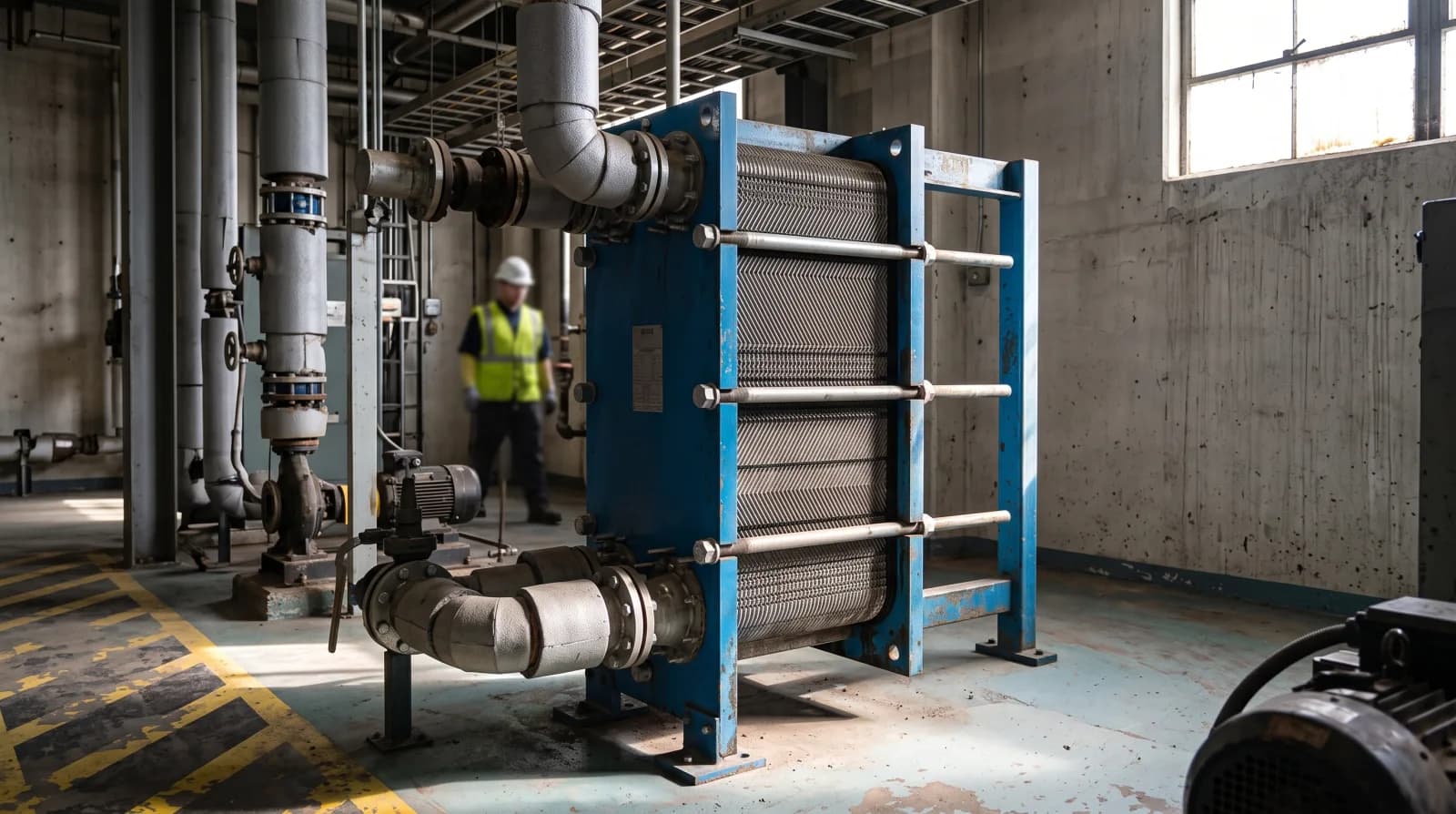
Welded plate heat exchanger repairs
Welded plate heat exchanger repairs clean and repair packs that do not come apart like a gasketed unit. Send the nameplate and what has happened, and a specialist who works on that type will come back to you. Coverage is UK wide.
Tell us about your welded plate heat exchanger repairs
Five answers, all from memory. The detail comes next, and it is optional.
See the privacy notice for how these details are handled.
Common plate heat exchanger problems
Weeping at the pack
A leak along the edge of the plate pack, usually the gaskets rather than the plates.
Regasketing →Cross contaminationThe two fluids are mixing
Product or utility appearing on the wrong side, which normally means a cracked plate.
Repair options →Losing dutyPressure drop up, duty down
Fouling between the plates, widening the approach temperature and restricting flow.
Cleaning options →UnsureNot sure what is wrong
Send the nameplate and what you have noticed. That is enough to get an answer.
Send the details →Welded plate repairs cover
Welded plate heat exchanger repairs are limited by construction rather than by condition. A semi-welded pack can be opened on the gasketed side; a fully welded one cannot be opened at all, which is the first thing to establish.
- Leaks between the circuits on a welded or semi-welded pack
- Fouling that has raised pressure drop and taken the duty away
- Gasket failure on the gasketed side of a semi-welded unit
- Corrosion or damage to the frame, ports or connections
- Cleaning and servicing on a unit that has not failed
What happens next
Send the details
The make, model and nameplate matter more here than on a gasketed unit, because what can be done depends on the construction.
A specialist makes contact
To establish whether the unit is fully welded or semi-welded, which decides what is possible.
Clean and assess
Welded packs are cleaned chemically, because the plate pack does not come apart the way a gasketed one does.
Repair or replace
Semi-welded units can be opened on the gasketed side. On a fully welded pack the realistic options are narrower, and that is established at the enquiry.
What affects the job
Welded or semi-welded
A semi-welded unit has welded pairs with gaskets between them, so one side can be opened. A fully welded pack cannot be opened at all, which changes everything about the repair.
Cleaning is the main service
Because the pack does not come apart, chemical cleaning does most of the work, and the chemistry has to suit both the deposit and the plate material.
Leak location
Finding a leak in a welded pack is harder than in a gasketed one, and what can be done about it once found is more limited.
Replacement economics
Where a welded pack has failed internally, replacement is more often the answer than it is on a gasketed unit, and it is better to know that early.
Welded plate heat exchanger repairs questions
Can a welded plate heat exchanger be repaired?
The construction decides it, along with where the failure is. Semi-welded units can be opened on the gasketed side and repaired much like a gasketed pack. A fully welded pack cannot be opened, so the options are cleaning, external repair or replacement.
How is a welded pack cleaned?
Chemically, circulated through the unit, because the plates cannot be removed. The chemistry is chosen for the deposit and for the plate material.
What is a semi-welded plate heat exchanger?
One where plates are welded in pairs and the pairs are sealed to each other with gaskets. It suits duties where one fluid is aggressive to gaskets and the other is not.