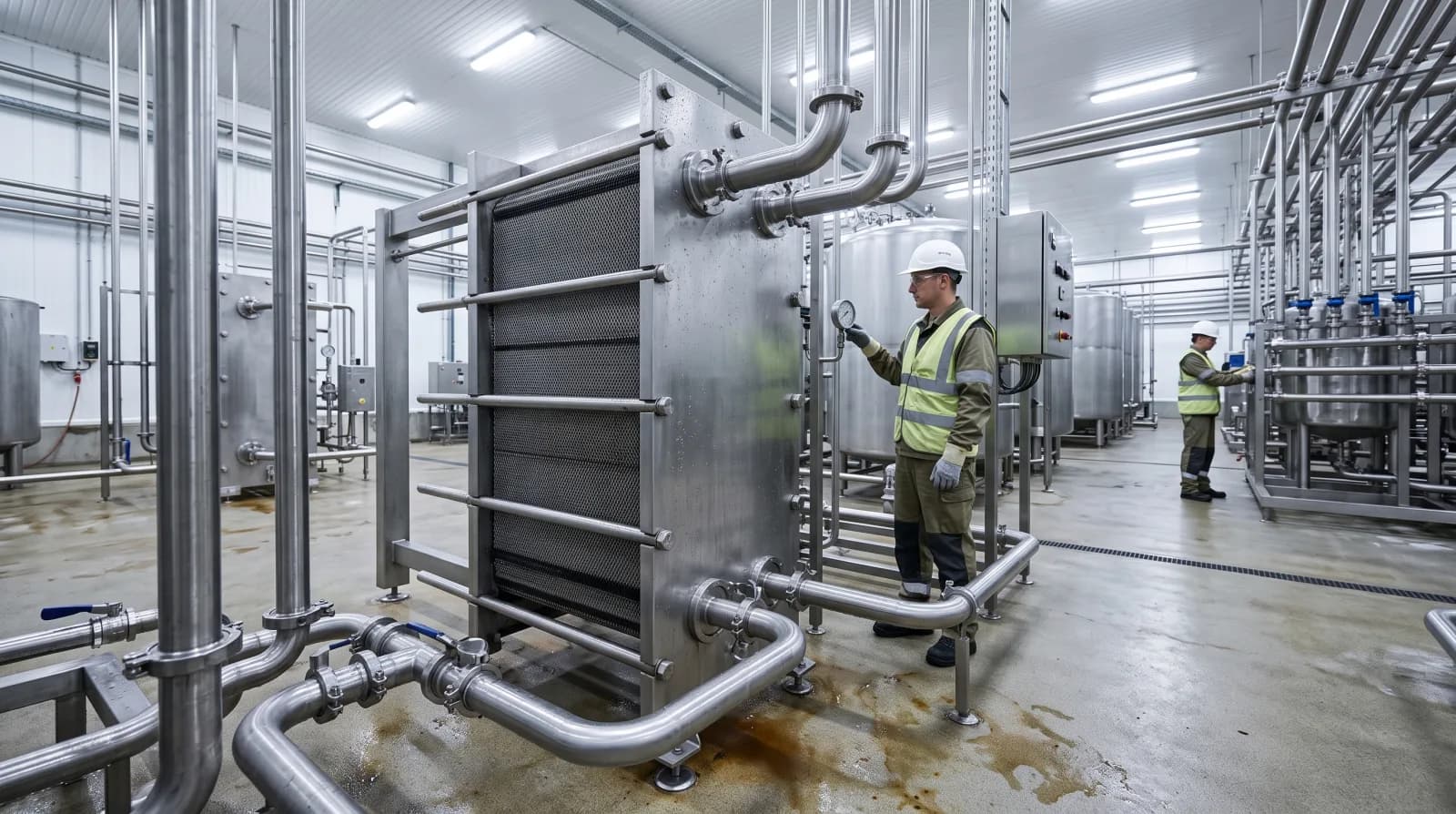
GEA heat exchanger repair
GEA heat exchanger repair covers pasteurisers, product coolers and process packs on food and dairy plant. Send the nameplate and what has happened, and a specialist who works on that type will come back to you. Coverage is UK wide.
Tell us about your GEA heat exchanger repair
Five answers, all from memory. The detail comes next, and it is optional.
See the privacy notice for how these details are handled.
Common GEA heat exchanger problems
It has failed or is leaking
Fluids mixing, a leak at the unit, or one that will not hold pressure.
Emergency repair →Losing dutyPerformance has dropped
Higher pressure drop, a wider approach temperature, or a duty it no longer reaches.
Cleaning options →PlannedA service or shutdown is coming
Planned maintenance, an outage window, or a spare that needs to be ready.
Servicing options →UnsureNot sure what is wrong
Send the nameplate and what you have noticed. That is enough to get an answer.
Send the details →GEA units covered
GEA heat exchanger repair most often means a unit on a hygienic duty: pasteurisers, product coolers and heat recovery in dairy, brewing and food processing. That duty, rather than the badge, sets the constraint, because the unit has to go back fit for product service.
- Gasketed plate units on dairy, brewing and food duties
- Process and utility packs on industrial sites
- Units badged Kelvion, the former GEA Heat Exchangers business
What can be arranged for GEA units
- Strip and clean with chemistry chosen for the deposit and the duty
- Dye penetrant inspection, which is what protects against product contamination
- Regasketing in a material acceptable for contact with product
- Plate replacement where a plate fails inspection
- Independent pressure testing of each circuit before return to service
GEA heat exchanger questions
Is a GEA unit the same as a Kelvion one?
They share a lineage. GEA Heat Exchangers was sold in 2014 and renamed Kelvion in November 2015, while GEA itself continues as a separate company, so plant of a certain age carries the GEA badge on equipment now supported under the Kelvion name. For a repair the nameplate settles it either way.
The unit is on a food duty. Does that change the repair?
It changes the cleaning chemistry, the rinse and the gasket material, because the unit has to be left fit to return to product service. The mechanical work is unchanged.
Fluids are mixing. Is that a gasket?
Usually not. Product crossing into a utility circuit normally means a cracked or perforated plate, which dye penetrant testing finds and which needs that plate replaced.
This site is not affiliated with, authorised by or endorsed by any manufacturer named on it. Manufacturer names and model designations are used only to identify the equipment a repair relates to.