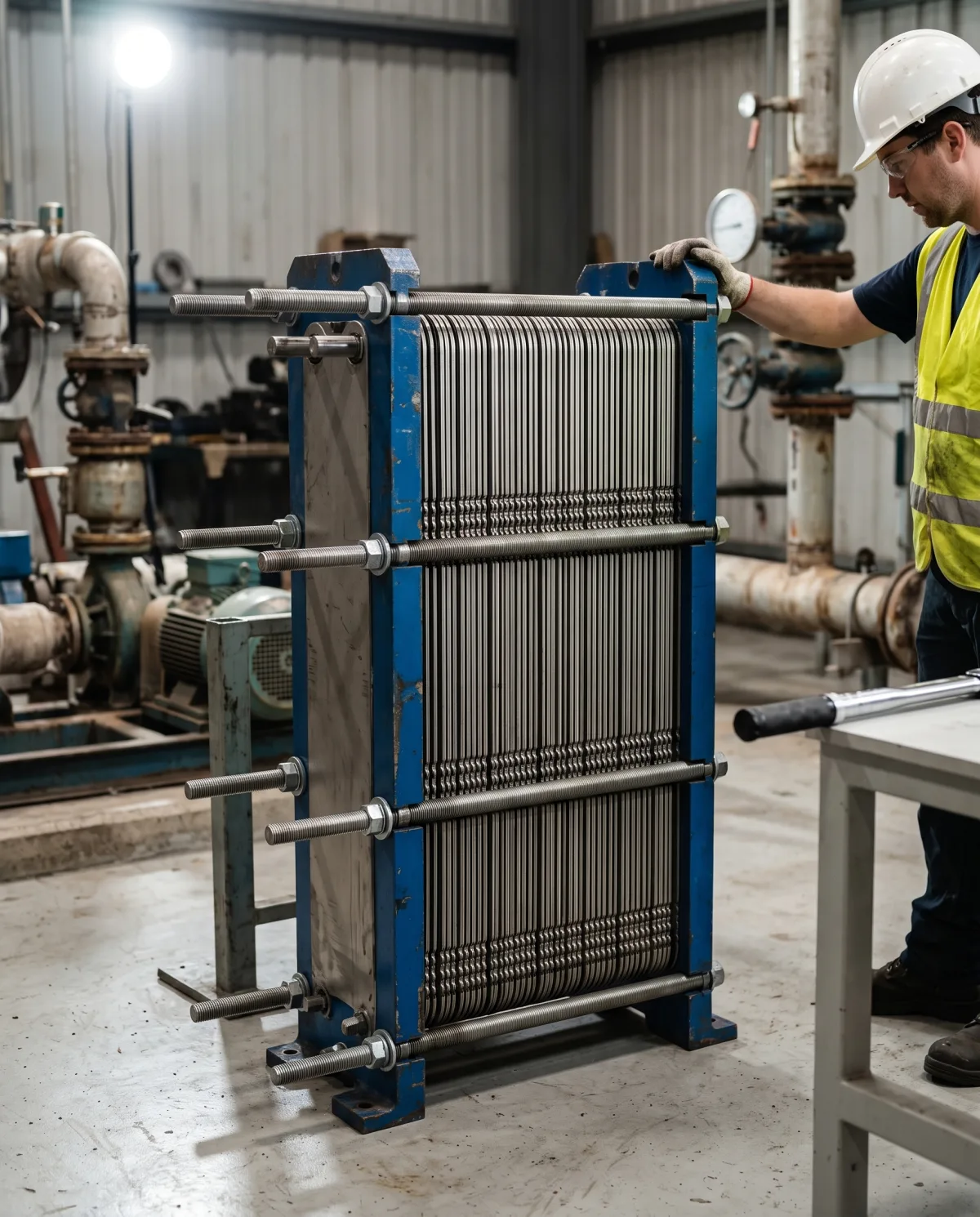
How a plate heat exchanger rebuild works
Plate heat exchanger rebuild takes a pack apart plate by plate and puts it back to dimension. This guide sets out what the decision rests on and what to gather before you make it.
Tell us about your repair or service
Five answers, all from memory. The detail comes next, and it is optional.
See the privacy notice for how these details are handled.
Common heat exchanger problems
It has failed or is leaking
Fluids mixing, a leak at the unit, or one that will not hold pressure.
Emergency repair →Losing dutyPerformance has dropped
Higher pressure drop, a wider approach temperature, or a duty it no longer reaches.
Cleaning options →PlannedA service or shutdown is coming
Planned maintenance, an outage window, or a spare that needs to be ready.
Servicing options →UnsureNot sure what is wrong
Send the nameplate and what you have noticed. That is enough to get an answer.
Send the details →The short answer
Record plate order and pack dimension before anything is slackened.
Clean first, because nothing can be assessed through deposit.
Every plate gets dye penetrant tested. Cracked plates are replaced, never repaired.
All gaskets, every time, in a material chosen for the duty.
Tighten evenly to dimension, and resist tightening further to stop a weep.
For anyone sending a plate pack away, or deciding whether to have the work done on site.
Record it before anything is touched
Plate order, plate orientation and the tightened pack dimension are written down before a nut is slackened. Plates are not interchangeable and the hanging sequence is not something to reconstruct afterwards. A pack reassembled in the wrong order does not work, and the fault is not obvious until it is back in service and behaving strangely.
The tightened dimension matters for a different reason. It is the figure the pack is rebuilt to, and it is also the record of how much tightening the pack has already had over its life.
Stripping and cleaning
The pack is opened, the plates come off the carrying bar, and they are cleaned. In a workshop that means heated, agitated chemical tanks, with the chemistry chosen for the deposit and for the plate material. That is a gentler process than water blasting or scrubbing with a wire brush, as well as a more thorough one, and the plate surface is what does the heat transfer, so protecting it matters.
Cleaning has to come before assessment. Nothing useful can be judged through a layer of deposit, which is why a clean is not an alternative to an inspection but a prerequisite for one.
Removing the gaskets without damaging the plate
Workshop practice is to freeze the gaskets off using liquid nitrogen, which releases them without attacking the plate. The field alternatives, a propane torch or a rotating wire brush, both risk damaging the plate and the gasket groove, and the plate is the expensive component. This is one of the clearest differences between work done properly in a workshop and work done in a plantroom because there was no other option.
Once the gasket is off, the groove is cleaned back completely. Old adhesive left behind means the new gasket is bonded to residue rather than to the plate, which is a leak with a delay built into it.
Inspecting every plate
Each plate is dye penetrant tested under ultraviolet light. This finds cracks and pinholes, which is what causes fluids to cross between circuits, and it is the step that decides whether a plate is reusable.
It is worth being clear about what this test is and is not. It is crack detection on a bare plate, not a leak test. Nothing is pressurised, and it will find a crack that has not yet started passing fluid, which is exactly the point. Pressure testing comes later, on the assembled unit, and answers a different question.
Cracks concentrate at the ports and in the herringbone where plates contact each other, which is where the stress and the fretting are. A plate that fails inspection is replaced. There is no repair for a cracked plate, and attempting one leaves you with the contamination you brought the unit in to stop.
Regasketing
Gaskets go back as a full set, never selectively. They are all the same age, in the same fluid, at the same temperature, so replacing only the failed ones means another visit shortly afterwards.
Material is chosen for the duty rather than copied from what came off, because what came off may itself have been the reason for the failure. Nitrile, EPDM and fluoroelastomers each have their range, and in food and brewing work the gasket has to survive the cleaning chemistry as well as the product.
Glued gaskets are bonded with a two part epoxy and cured in an oven under compression for several hours. Clip-on gaskets need no adhesive but do need an undamaged groove.
Rebuilding and testing
Plates go back in the recorded order and orientation, and the pack is tightened evenly to the specified dimension. Evenly matters as much as the figure: tightening one corner ahead of the others distorts the pack and the gaskets do not seat properly.
Over-tightening is the most common cause of a fresh rebuild leaking early. It crushes new gaskets, shortens their life, and takes the pack closer to the minimum dimension below which it cannot seal at all.
Both sides are then pressure tested independently. Testing them together can conceal a leak between circuits entirely, because the pressure is equal either side of the failure.
Where rebuilds go wrong
- Plates reassembled out of order
- Avoided entirely by recording the pack before stripping it, and very difficult to recover from afterwards.
- Gaskets replaced selectively
- The ones left in are the same age as the ones that failed.
- Over-tightening
- Crushes new gaskets and consumes the pack's remaining tightening allowance.
- Inspection skipped because the plates look clean
- Clean plates can be cracked. Looking at them is not inspecting them.
- Gasket material carried over without thought
- Particularly where the original material was wrong for the duty.
Send an enquiry
Five answers to start, and the detail after. The enquiry is sent as soon as you have given the first five, so nothing is lost if you stop there.
What to copy off it
Make, model and serial number, design pressure and temperature, test pressure and year of manufacture. A photograph of the plate is quicker than typing it out.
Tell us about your repair or service
Five answers, all from memory. The detail comes next, and it is optional.
See the privacy notice for how these details are handled.