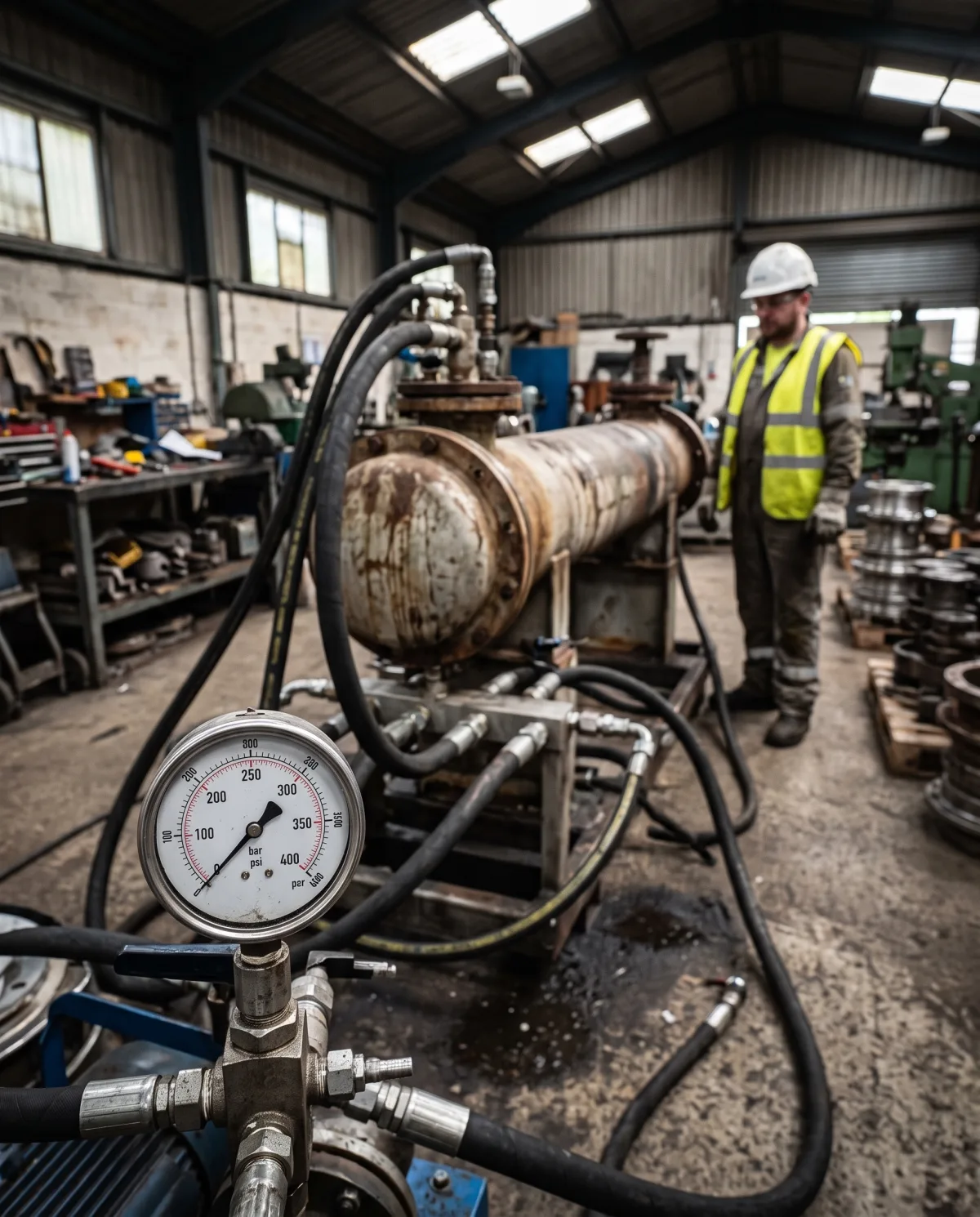
Heat exchanger performance testing
Heat exchanger performance testing measures the duty a unit is really delivering. Send the nameplate and what has happened, and a specialist who works on that type will come back to you. Coverage is UK wide.
Tell us about your heat exchanger performance testing
Five answers, all from memory. The detail comes next, and it is optional.
See the privacy notice for how these details are handled.
Common problems that need heat exchanger performance testing
It has failed or is leaking
Fluids mixing, a leak at the unit, or one that will not hold pressure.
Emergency repair →Losing dutyPerformance has dropped
Higher pressure drop, a wider approach temperature, or a duty it no longer reaches.
Cleaning options →PlannedA service or shutdown is coming
Planned maintenance, an outage window, or a spare that needs to be ready.
Servicing options →UnsureNot sure what is wrong
Send the nameplate and what you have noticed. That is enough to get an answer.
Send the details →When performance testing is worth doing
Heat exchanger performance testing measures what a unit is delivering against what it was designed to deliver. Testing turns an argument about efficiency into a figure, and a figure is what makes a cleaning or replacement decision affordable to take.
- Before deciding whether to clean, repair or replace, so the decision rests on evidence
- After a clean or a repair, to prove the duty has actually come back
- When downstream plant is working harder and the exchanger is suspected
- When energy consumption has risen with no other explanation
- On a new or modified duty, to establish a baseline worth measuring against later
What is measured
Temperatures, both sides, in and out
Four readings, and they give the approach temperature, which is the single most useful indicator of how a unit is performing.
Pressure drop across the unit
Rising pressure drop at the same flow points at fouling or restriction. Falling duty with no change in pressure drop points somewhere else entirely.
Flow rates
Without flow, temperatures alone can mislead. A unit starved of flow looks like a fouled unit until the flow is checked.
Comparison against the design
The datasheet says what the exchanger was sized to do. The gap between that and what it is doing is the thing worth acting on.
Getting a meaningful result
Test at steady conditions
Readings taken while the process is settling do not compare with anything. Stable operation matters more than instrument precision.
Measure the same way each time
One set of readings gives a snapshot; a series gives a rate, and the rate is what a cleaning interval is built on. Consistency of method matters more than instrument precision.
Know what the design figures were
Without the datasheet there is no benchmark, only a comparison with the last reading, which is still useful but slower to build.
Rule out the system first
Pumps, valves, control settings and air in the circuit all look like exchanger problems from the control room.
Heat exchanger performance testing questions
Which parameters show the condition of a heat exchanger in operation?
Inlet and outlet temperatures on both sides, pressure drop across each side, and flow. Together they give the approach temperature and the trend, which is what shows condition without opening the unit.
What is an acceptable pressure drop in a heat exchanger?
The design figure for that unit, which is on its datasheet. There is no general number worth quoting, because it depends on the duty, the geometry and the flow. What matters is the change from the clean condition.
What is a good approach temperature?
The unit's own design decides it, which is why the datasheet is the benchmark and a general rule is not. What matters is the change from where it started.
Can performance be tested while the plant runs?
Yes, and in most cases that is the point. The readings are taken in normal operation, since the question is what the unit is delivering in service.
Will testing tell me whether to clean or repair?
Testing tells you how much duty you are losing and how quickly. What the deposit or damage actually is still needs the unit opened.