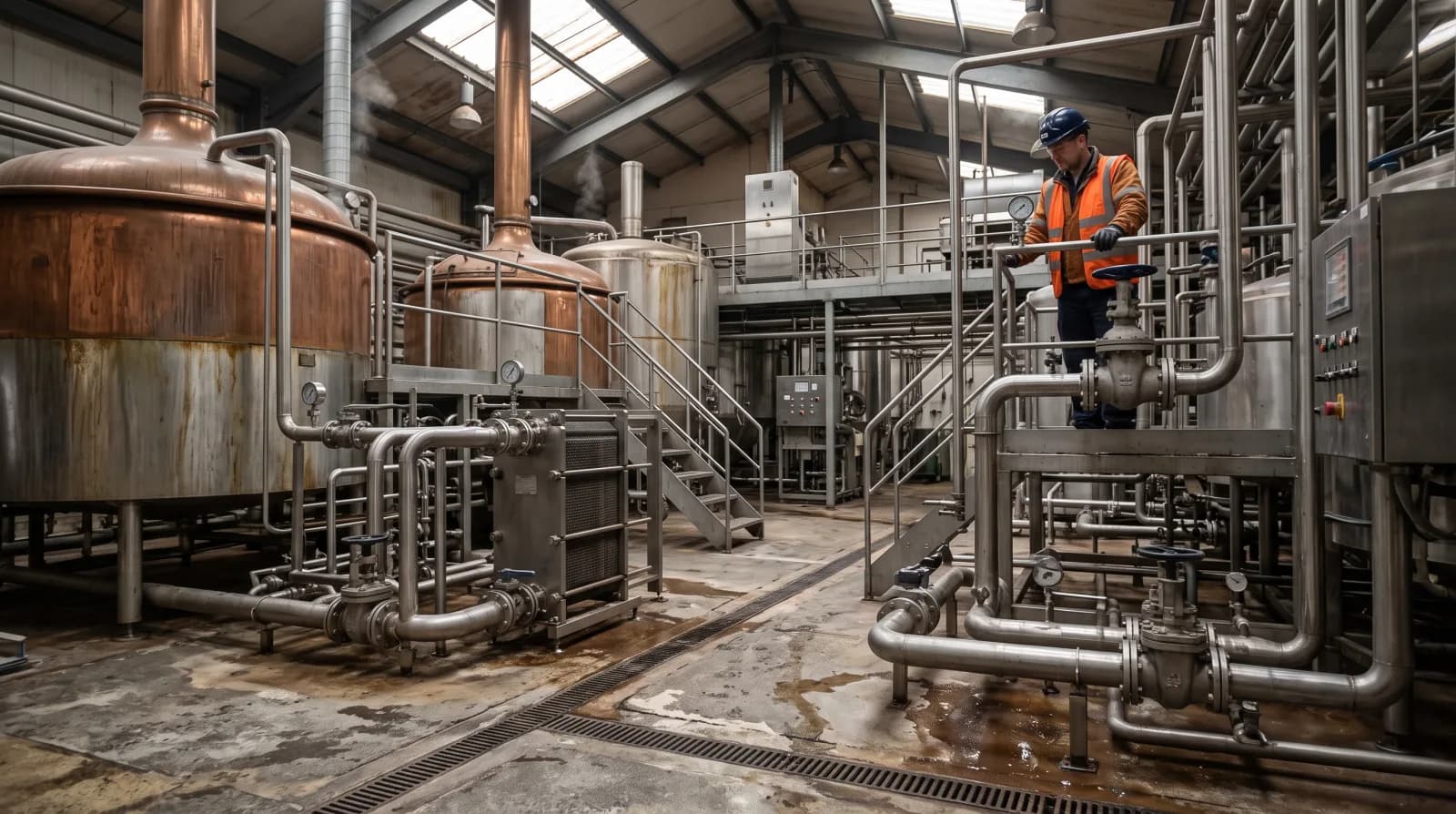
Heat exchanger repairs for brewing and distilling
Heat exchanger repairs for brewing and distilling cover wort coolers, heat recovery and still condensers. Send the nameplate and what has happened, and a specialist who works on that type will come back to you. Coverage is UK wide.
Tell us about your brewing and distilling
Five answers, all from memory. The detail comes next, and it is optional.
See the privacy notice for how these details are handled.
Common heat exchanger problems for brewing and distilling
It has failed or is leaking
Fluids mixing, a leak at the unit, or one that will not hold pressure.
Emergency repair →Losing dutyPerformance has dropped
Higher pressure drop, a wider approach temperature, or a duty it no longer reaches.
Cleaning options →PlannedA service or shutdown is coming
Planned maintenance, an outage window, or a spare that needs to be ready.
Servicing options →UnsureNot sure what is wrong
Send the nameplate and what you have noticed. That is enough to get an answer.
Send the details →Heat exchangers used in brewing and distilling
Heat exchanger repairs for brewing and distilling work around the production calendar rather than the equipment. Wort coolers and heat recovery units foul on both sides at once, from trub and protein one way and cooling water scale the other.
- Plate wort coolers, often two stage with water then glycol
- Heat recovery exchangers capturing heat from wort into liquor
- Condensers and coolers on stills in distilleries, frequently in copper or stainless
- Utility plate exchangers on glycol, hot liquor and CIP sets
- Tubular units where solids make plates impractical
How fouling affects brewery heat exchangers
- Trub, protein and hop debris
- Wort carries solids. Trub and hop material entering the cooler blocks channels rather than coating them evenly, so the symptom is often flow and pressure drop before it is heat transfer.
- Blocked channels rather than general fouling
- That distinction matters. General fouling responds to circulated chemistry; a channel packed with solids often does not, and the pack has to come apart.
- Beerstone and scale
- Mineral deposit builds on surfaces in contact with wort and beer, and it bonds hard. Acid cleaning addresses it, and the chemistry has to suit the plate material.
- Biological risk
- Any deposit is somewhere for spoilage organisms to survive a clean. Fouling is a product quality issue here as much as a thermal one.
What affects heat exchanger repairs in brewing and distilling
The brew calendar decides everything
In a brewery the cooler is needed on every brew day, so work happens between brews or not at all. In distilling the traditional silent season is when maintenance is possible, and it is planned a long way ahead.
Copper in distilling
Copper is there for the spirit, not just for heat transfer, and it is softer and thinner than the stainless most cleaning regimes assume. Method and chemistry have to reflect that.
Cleaning chemistry against materials
Caustic and acid cycles are routine here, and the gaskets and plates live in them as well as in the product. Material choice has to survive the cleaning as much as the duty.
Small sites, no spares
Craft breweries and smaller distilleries rarely hold a spare pack, so turnaround matters more than it does on a large plant with redundancy. Knowing plate and gasket availability before opening the unit is worth more here than anywhere.
Brewing and distilling questions
The wort cooler is not reaching pitching temperature. Where do we start?
Usually fouling or partial blockage in the plate pack, particularly if pressure drop has risen at the same time. Worth ruling out coolant temperature and flow first, since a glycol problem produces the same symptom and is quicker to check.
Can the cooler be cleaned without stripping it?
Circulated caustic and acid cycles handle routine fouling and should be the normal regime. Circulated cleans do not clear a channel packed with trub or hop material, and they cannot establish whether a plate has cracked.
When is the right time to service?
Between brews in a brewery, and in the silent season in a distillery. Booking it against the production calendar rather than against a maintenance interval is what makes the difference between planned work and an emergency.