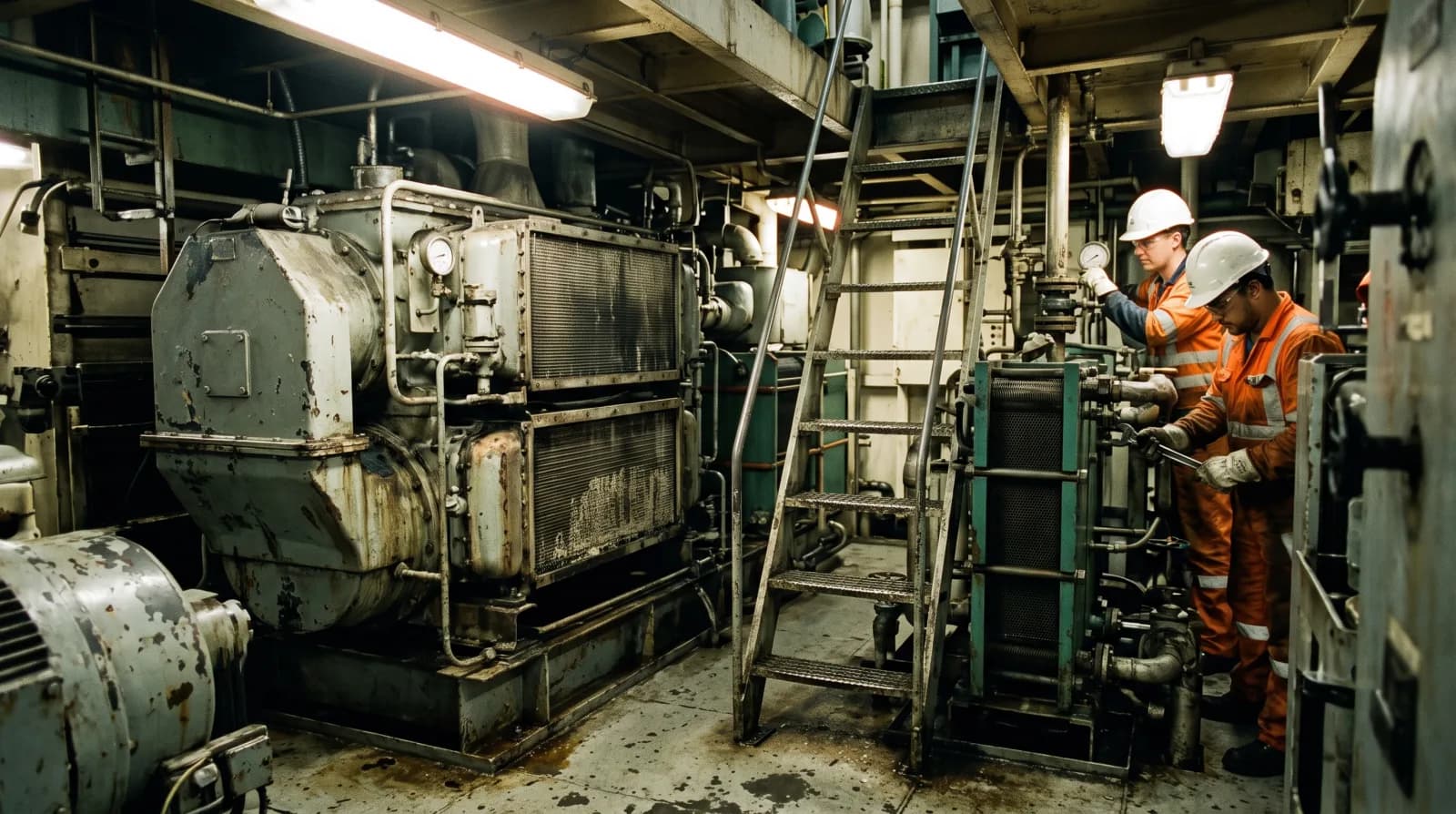
Heat exchanger repairs for marine and shipping
Heat exchanger repairs for marine and shipping cover coolers, charge air coolers and central cooling on ships. Send the nameplate and what has happened, and a specialist who works on that type will come back to you. Coverage is UK wide.
Tell us about your marine
Five answers, all from memory. The detail comes next, and it is optional.
See the privacy notice for how these details are handled.
Common heat exchanger problems for marine and shipping
It has failed or is leaking
Fluids mixing, a leak at the unit, or one that will not hold pressure.
Emergency repair →Losing dutyPerformance has dropped
Higher pressure drop, a wider approach temperature, or a duty it no longer reaches.
Cleaning options →PlannedA service or shutdown is coming
Planned maintenance, an outage window, or a spare that needs to be ready.
Servicing options →UnsureNot sure what is wrong
Send the nameplate and what you have noticed. That is enough to get an answer.
Send the details →Heat exchangers used on ships
Heat exchanger repairs for marine and shipping have to fit the time alongside. Seawater cooling brings inlet end erosion and chloride pitting, and the survey regime sets what has to be recorded.
- Central coolers, commonly titanium plate packs on seawater duty
- Charge air coolers on main and auxiliary engines
- Lube oil and jacket water coolers
- Condensers and evaporators, including fresh water generators
- Shell and tube coolers on older tonnage where plates have not replaced them
How fouling affects marine heat exchangers
- Seawater is aggressive and variable
- Chloride attack, and behaviour that changes with temperature and with where the vessel is. A cooler that behaves in one trade can foul or corrode quickly in another.
- Erosion and corrosion together
- High velocity seawater carrying silt attacks the surface mechanically and chemically at once. Damage concentrates at inlets and at changes of direction rather than spreading evenly.
- Biofouling and marine growth
- Organisms settle and grow in the seawater side, and shells and debris block channels outright. Growth rates vary with trade, with lay-up periods and with the effectiveness of any marine growth prevention system.
- Galvanic issues and anodes
- Mixed metals in a conductive electrolyte make galvanic corrosion a live problem. Anodes are consumable, and once they are spent the corrosion moves to something that is not.
- Oil side fouling on charge air
- Turbocharger oil carryover coats the air side of the charge air cooler, raising charge air temperature and exhaust temperatures without any fault appearing.
What affects heat exchanger repairs on a vessel
The port call is the window
Work is bounded by the time alongside, which decides between a repair, a swap for a spare, and a temporary measure until dry dock. That decision is usually made with incomplete information and under time pressure.
Survey and class
Machinery is surveyed to a class regime, so a repair has to be acceptable to the surveyor as well as to the engineers. Records and test certificates matter as much as the work.
Spares held on board
What is in the store decides what is possible at sea. Gaskets, plates and tube plugs held on board turn a failure into an inconvenience; not holding them turns it into a port call.
Working space
Engine rooms are not workshops. Access, lifting and somewhere to put a plate pack are real constraints and often decide the method.
Titanium behaves differently
Titanium plates handle seawater well and tolerate chemistry that would attack stainless, but they are thin and easily damaged mechanically. Cleaning method follows the material.
Marine questions
There is water in the charge air receiver. How urgent is that?
Treat it as a cooler tube leak until proven otherwise, and investigate before running on, because the water ends up in the cylinders. Condensation in humid conditions can produce the same sign, and a pressure test of both circuits separately is what tells you which it is.
How often should seawater coolers be opened?
More often than an equivalent shore unit, and the interval should follow the trade rather than a generic schedule. Seawater temperature, silt, growth and lay-up periods all change the rate, so condition monitoring beats a fixed calendar here.
Can plate packs be serviced on board?
Opening a pack and replacing gaskets is done on board where there is room and the spares are held. Proper tank cleaning and inspection under ultraviolet light needs a workshop, so on board work leaves plate condition unproven.