Heat exchanger repairs on Teesside
Heat exchanger repairs on Teesside cover the chemical works and process plant along the Tees. Send the nameplate and what has happened, and a specialist who works on that type will come back to you. Coverage is UK wide.
Tell us about your teesside
Five answers, all from memory. The detail comes next, and it is optional.
See the privacy notice for how these details are handled.
Common heat exchanger problems on Teesside
It has failed or is leaking
Fluids mixing, a leak at the unit, or one that will not hold pressure.
Emergency repair →Losing dutyPerformance has dropped
Higher pressure drop, a wider approach temperature, or a duty it no longer reaches.
Cleaning options →PlannedA service or shutdown is coming
Planned maintenance, an outage window, or a spare that needs to be ready.
Servicing options →UnsureNot sure what is wrong
Send the nameplate and what you have noticed. That is enough to get an answer.
Send the details →Industrial plant on Teesside
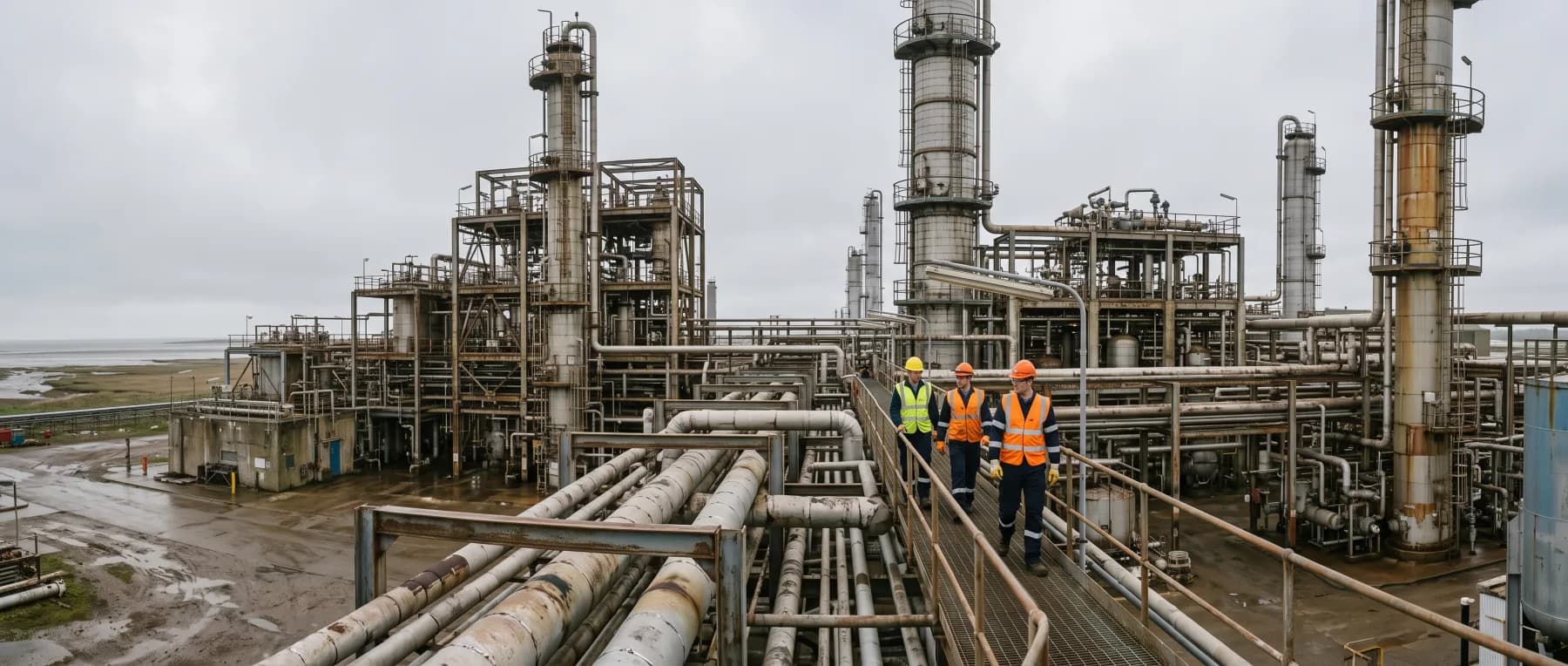
Heat exchanger repairs on Teesside serve the UK's largest chemical cluster, and with it one of the densest populations of shell and tube plant in the country.
- Three sites along twelve miles of river
- Wilton International, Billingham, and Seal Sands and North Tees run roughly twelve miles east to west either side of the Tees. That geography is why so much of the plant here runs on shared pipeline systems instead of standing alone.
- One of Europe's largest gas crackers
- SABIC's cracker sits at Wilton, and cracker complexes carry heat exchangers in quantity: feed and effluent trains, quench, and the column reboilers and condensers behind every separation stage.
- An industrial gas grid
- BOC Linde operates one of the world's largest industrial gas pipeline networks here, supplying hydrogen, oxygen, nitrogen and argon across the cluster. Cryogenic and gas processing duties bring their own exchanger types and their own material requirements.
- Around seventeen thousand chemical manufacturing jobs
- Roughly five billion pounds of chemical output. This is a working cluster with shutdown programmes and turnaround cycles, not a legacy site, and Lotte Chemical's PET plant and newer processing ventures continue to add to it.
Heat exchangers used on Teesside
- Shell and tube units in large numbers, many in trains rather than singly
- Air-cooled fin fan coolers where cooling water is constrained
- Column reboilers and overhead condensers on every separation stage
- Plate exchangers on closed cooling water and utility duties
- High specification metallurgy where the process demands it
Teesside questions
Is Teesside work turnaround driven?
Largely, yes. Anything invasive waits for a shutdown, which is scoped and resourced well in advance. Inspection between turnarounds is what gets the right scope and the right materials into the plan rather than discovered during it.
What is different about working in a cluster like this?
Permits, isolation and hot work controls govern access, and units are frequently connected by pipeline to neighbouring plant. Permits and hot work controls push repairs toward methods that avoid welding, which is part of why mechanical tube plugs have displaced welded tapered plugs on a lot of sites.