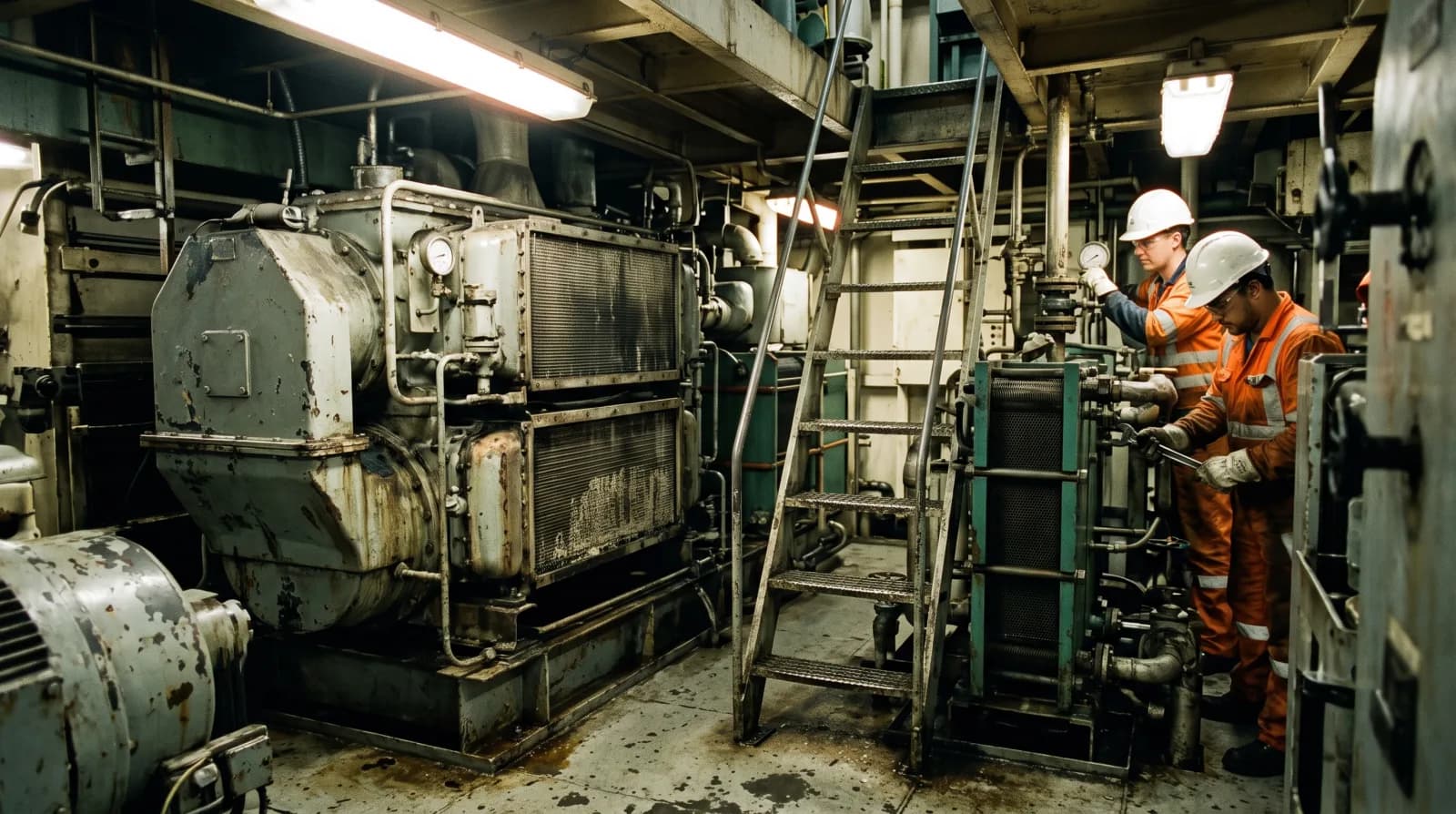
Hisaka heat exchanger repair
Hisaka heat exchanger repair covers plate coolers on ships and on process plant ashore. Send the nameplate and what has happened, and a specialist who works on that type will come back to you. Coverage is UK wide.
Tell us about your Hisaka heat exchanger repair
Five answers, all from memory. The detail comes next, and it is optional.
See the privacy notice for how these details are handled.
Common Hisaka heat exchanger problems
It has failed or is leaking
Fluids mixing, a leak at the unit, or one that will not hold pressure.
Emergency repair →Losing dutyPerformance has dropped
Higher pressure drop, a wider approach temperature, or a duty it no longer reaches.
Cleaning options →PlannedA service or shutdown is coming
Planned maintenance, an outage window, or a spare that needs to be ready.
Servicing options →UnsureNot sure what is wrong
Send the nameplate and what you have noticed. That is enough to get an answer.
Send the details →Hisaka units covered
Hisaka heat exchanger repair often means marine service. Hisaka Works of Japan has built plate heat exchangers since 1953 and its units are widely used on ships, where seawater cooling brings inlet end erosion and chloride pitting, and where the constraint is the time alongside.
- Gasketed plate units in marine central cooling and auxiliary service
- Process and industrial packs ashore
- Seawater cooled duties, often on titanium plates
What can be arranged for Hisaka units
- Strip, clean and rebuild, alongside where the port call allows
- Regasketing with the material matched to the duty
- Plate inspection for chloride pitting and cracking
- Pressure testing each side before the unit returns to service
Hisaka heat exchanger questions
Can the work be done alongside?
Sometimes, depending on access and the time in port. What can be done on board and what needs the unit ashore is the first thing to establish, because it usually decides the whole plan.
The plates are pitted. Does that mean replacement?
Only the plates that fail inspection. Chloride pitting on seawater duty is a common finding, and it is why plate material is worth reviewing at the same time: titanium tolerates seawater where stainless struggles.
What does the survey regime need?
Records of what was tested and at what pressure, which are produced as part of the work. Agreeing what the surveyor requires before the unit is opened avoids repeating anything.
This site is not affiliated with, authorised by or endorsed by any manufacturer named on it. Manufacturer names and model designations are used only to identify the equipment a repair relates to.