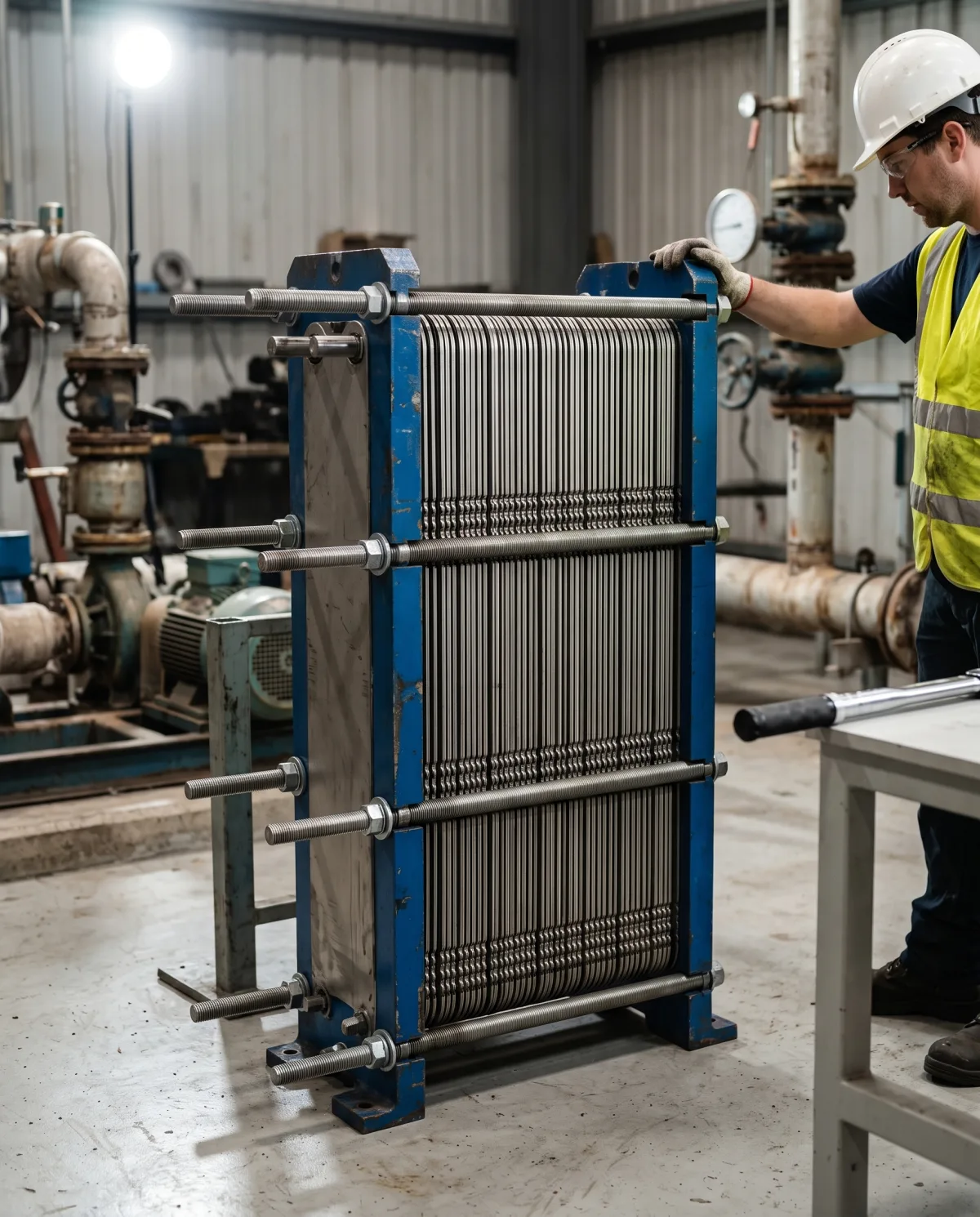
Plate heat exchanger refurbishment
Plate heat exchanger refurbishment rebuilds a tired pack plate by plate. Send the nameplate and what has happened, and a specialist who works on that type will come back to you. Coverage is UK wide.
Tell us about your plate heat exchanger refurbishment
Five answers, all from memory. The detail comes next, and it is optional.
See the privacy notice for how these details are handled.
Common plate heat exchanger problems
Weeping at the pack
A leak along the edge of the plate pack, usually the gaskets rather than the plates.
Regasketing →Cross contaminationThe two fluids are mixing
Product or utility appearing on the wrong side, which normally means a cracked plate.
Repair options →Losing dutyPressure drop up, duty down
Fouling between the plates, widening the approach temperature and restricting flow.
Cleaning options →UnsureNot sure what is wrong
Send the nameplate and what you have noticed. That is enough to get an answer.
Send the details →When to refurbish a plate heat exchanger
Plate heat exchanger refurbishment takes a pack back to a known condition: stripped, cleaned, inspected plate by plate, regasketed and rebuilt. Reconditioning and overhaul describe the same work. These are the cases that need it.
- A history of small failures rather than one clear fault
- A unit with no service history, or one inherited with the plant
- A standby unit that has to be genuinely ready, not simply listed as a spare
- A pack tightened repeatedly and now near its minimum dimension
- Plant coming out for a shutdown, where the outage is the constraint rather than the work
What a plate refurbishment covers
Record before stripping
The tightened pack dimension is measured and the plate hanging sequence photographed. That dimension is what the rebuild is tightened back to, and it is the figure a pack cannot be returned to service without.
Strip and clean every plate
Plates come out and are cleaned individually in heated chemical tanks. The chevron corrugations that make the unit efficient are also what traps deposit, and hand cleaning does not reach into them.
Inspect every plate
Dye penetrant under ultraviolet light finds the cracks and pinholes that cause cross contamination. Plate by plate inspection is what separates a refurbishment from a clean.
Replace what fails
Plates that fail inspection come out of the pack, and the gasket set goes back complete.
Rebuild and test
Plates return in their recorded order, the pack is compressed evenly to its dimension, and each side is pressure tested on its own.
Report
Which plates failed, what the gaskets looked like and what was fouling it. Set against the last report, that shows whether the interval is right.
What affects a plate refurbishment
How many plates fail inspection
Plates are the expensive part. Where enough of them fail, replacing the unit can beat rebuilding it, and the inspection report is what settles that.
Plate and gasket availability
Plates and gaskets are model specific. Where a model is discontinued, availability decides whether the pack is rebuilt at all, which is why it is checked before the unit is stripped.
On site or in a workshop
A workshop gets tank cleaning, inspection under ultraviolet light and oven cured gaskets. On site suits a straightforward regasket and little else.
Whether a spare exists
A spare pack turns the job into a changeover. Without one, the duty is off line for the duration.
Plate heat exchanger refurbishment questions
What is the difference between refurbishment and repair?
A repair addresses the fault that stopped the unit. A refurbishment takes the whole unit back to a known condition, which is why it is usually planned rather than reactive.
Is a refurbished plate heat exchanger as good as new?
For most duties, a unit with sound plates, new gaskets and a current pressure test is fit for its design conditions. What refurbishment does not do is change the design, so a unit that was undersized stays undersized.
Can it be done on site?
Not fully. Tank cleaning, inspection under ultraviolet light and oven cured gaskets all need a workshop, and moving the unit is usually cheaper than trying to recreate that in a plant room.